







AV over IP vs. HDBaseT: Which Technology Fits Your Next Project?
If you've spent any time shopping for a video distribution system, you've probably run into two terms that seem to do the same job: AV over IP and HDBaseT. Both promise to move a crisp 4K picture from a source to a screen across the building, both run over the same familiar Ethernet cable, and both show up in the spec sheets for gear you might be considering. So it's easy to assume they're interchangeable. And that's okay — they look almost identical from the outside.
They're not, though. Under the hood, these two technologies solve the same problem in completely different ways, and knowing the difference is the key to not overbuying or boxing yourself in. Let's break it down in plain language.
First, the Thing They Have in Common

Both AV over IP and HDBaseT send your audio and video down an ordinary network cable — the same Cat5e or Cat6 you'd use to plug a computer into the wall. That's the source of all the confusion. A cable is a cable, right?
Here's the key difference: HDBaseT uses that cable as a private, one-lane road between two points. AV over IP uses it to get onto the network — the same shared highway your computers, phones, and printers already travel on. Everything else that matters flows from that one distinction.
HDBaseT: The Really Long HDMI Cable
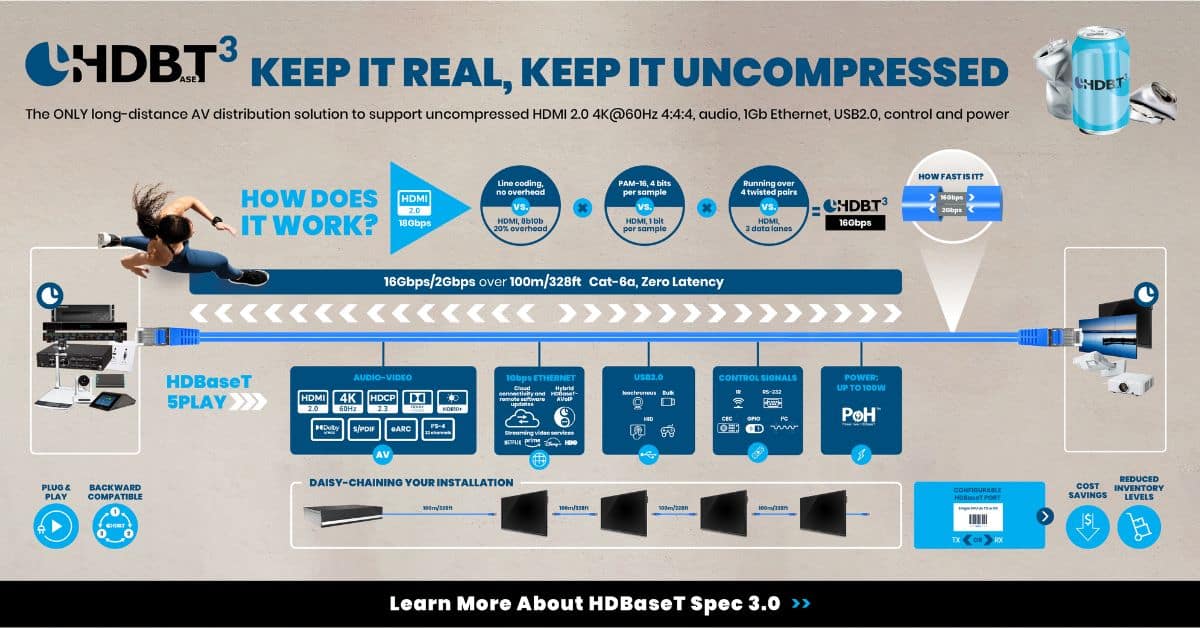
The easiest way to picture HDBaseT is as an HDMI cable that got stretched way, way out. You take a source — a laptop, a media player, a camera — plug it into a small transmitter box, run a single network cable to a receiver box on the far end, and your HDMI signal comes out the other side. Along with the picture, that one cable can also carry audio, control signals (the commands that turn a projector on or switch an input), and even a bit of Ethernet.
The important part is that HDBaseT runs point-to-point. The signal travels straight from the transmitter to the receiver on its own dedicated cable. It never touches your network, never gets an IP address, and never competes with your email or your Wi-Fi for space. Think of it like a private driveway between two houses — nothing else is allowed on it.
That's exactly why people love it. Because the signal has the road to itself, HDBaseT delivers rock-solid 4K with essentially zero delay and picture quality you can't tell apart from a direct HDMI connection. There's no configuring, no IT department, no surprises. For a single conference room, classroom, or worship space where the sources and screens are fixed, it just works.
The catch is distance and flexibility. HDBaseT tops out around 100 meters (roughly 330 feet) for 4K on a standard cable, and every source-to-screen pair generally needs its own connection. It's fantastic within a room, but it wasn't built to sprawl across an entire campus.
AV over IP: Video That Rides the Network

AV over IP — often shortened to AVoIP — takes the opposite approach. Instead of a private cable between each source and each screen, it puts your video onto a standard network and lets a network switch do the routing. Each source connects to an encoder (a device that packages video into network data), and each screen connects to a decoder (a device that unpacks it back into a picture). The switch in the middle sends any source to any screen you ask for.
Here's an analogy. A traditional matrix switcher is like a building with a fixed number of hardwired phone lines — when they're full, they're full. AV over IP is like putting every phone on the office network instead. Adding another line is just plugging in another device. Need one more screen next year? Add a decoder. Want to feed a video wall in the lobby, or send the same feed to overflow rooms on three different floors? The network already knows how to do that.
The trade-off is that your network becomes part of the AV system. AV over IP needs a properly set up switch and usually some help from your IT team to keep the video traffic organized and flowing smoothly. It asks a little more of whoever installs it — but in return, it can reach as far as your network reaches and grow as large as the building demands.
The Simple Way to Decide
Strip away the jargon and the choice usually comes down to two questions: how big is this system, and is it going to grow?
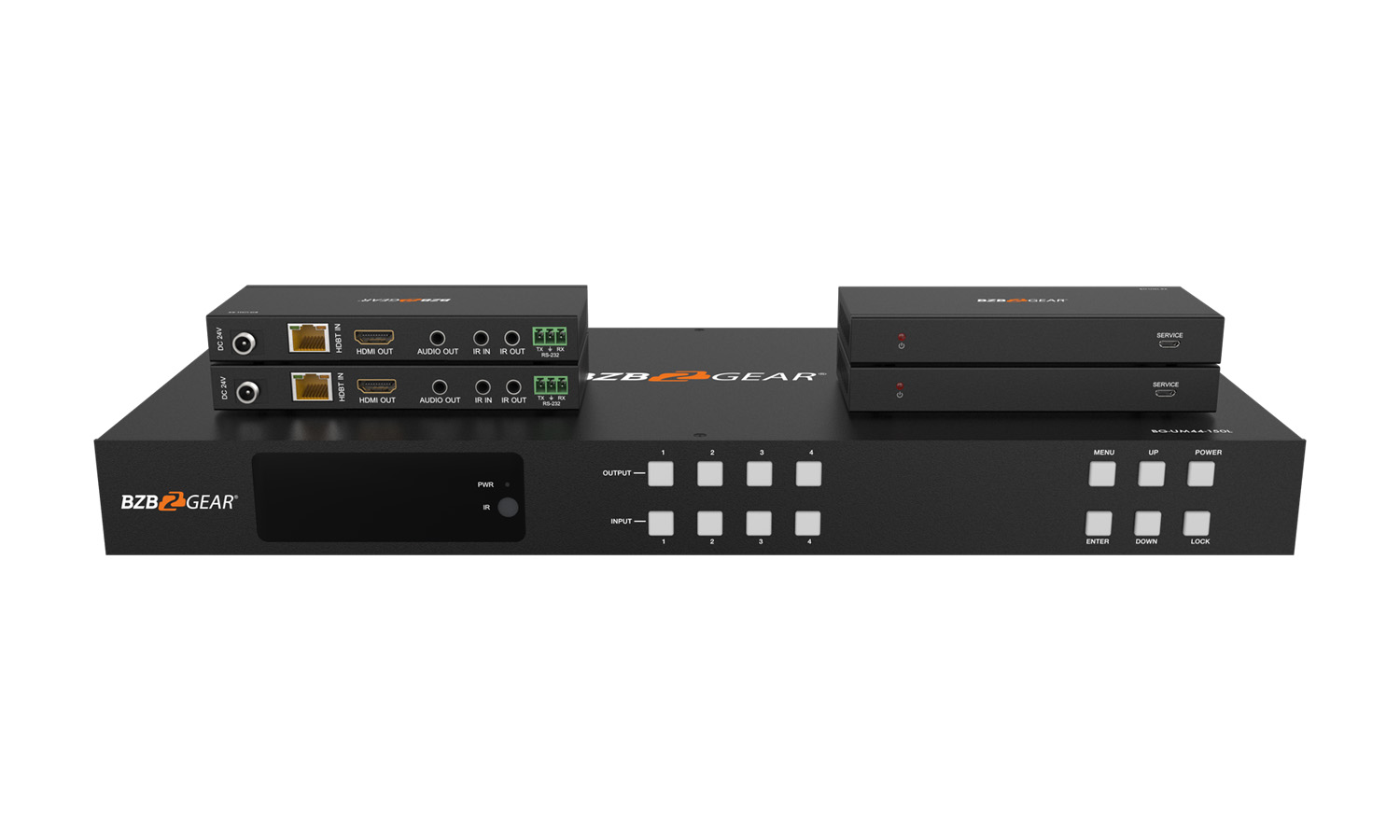
If your project lives inside a single, self-contained room with a fixed set of sources and screens — and you want the simplest, most bulletproof result — HDBaseT is almost always the smarter call. It's easy to install, it doesn't involve the network, and the performance is flawless. The BZBGEAR BG-EXH-150C HDMI extender is a great example: it pushes 4K@60Hz 4:4:4 up to 394ft (120m) — and 1080p out to 492ft (150m) — over a single cable, with 18Gbps of bandwidth and bi-directional IR, RS-232, and CEC control carried right alongside the video. For a room that needs switching between several sources and screens, the BG-UM44-150L-KIT (4x4) and BG-UM88-150L-KIT (8x8) matrix switchers deliver 4K@60Hz 4:4:4 HDMI switching with the HDBaseT extension built right in, so every output can reach a display across the room without a separate extender for each one.

If your project spans multiple rooms, several floors, or a whole campus — or if you know the screen count is going to climb over time — AV over IP is the answer. Houses of worship with overflow spaces, schools, sports venues with concourse displays, and digital signage networks all play to its strengths. The BZBGEAR BG-IPGEAR-PRO series is built for exactly this. It uses separate transmitter (BG-IPGEAR-PRO-T) and receiver (BG-IPGEAR-PRO-R) units, so you add only what each room needs, delivers 4K@60Hz 4:4:4 video over standard Gigabit Ethernet with Power over Ethernet (so one cable handles both video and power), and carries KVM control and video-wall capability along the way. Pair it with the smart controller (BG-IPGEAR-PRO-C), which auto-discovers every device on the network to keep setup simple and can manage up to 1,024 units on a single system — plenty of room for even a big venue to grow.
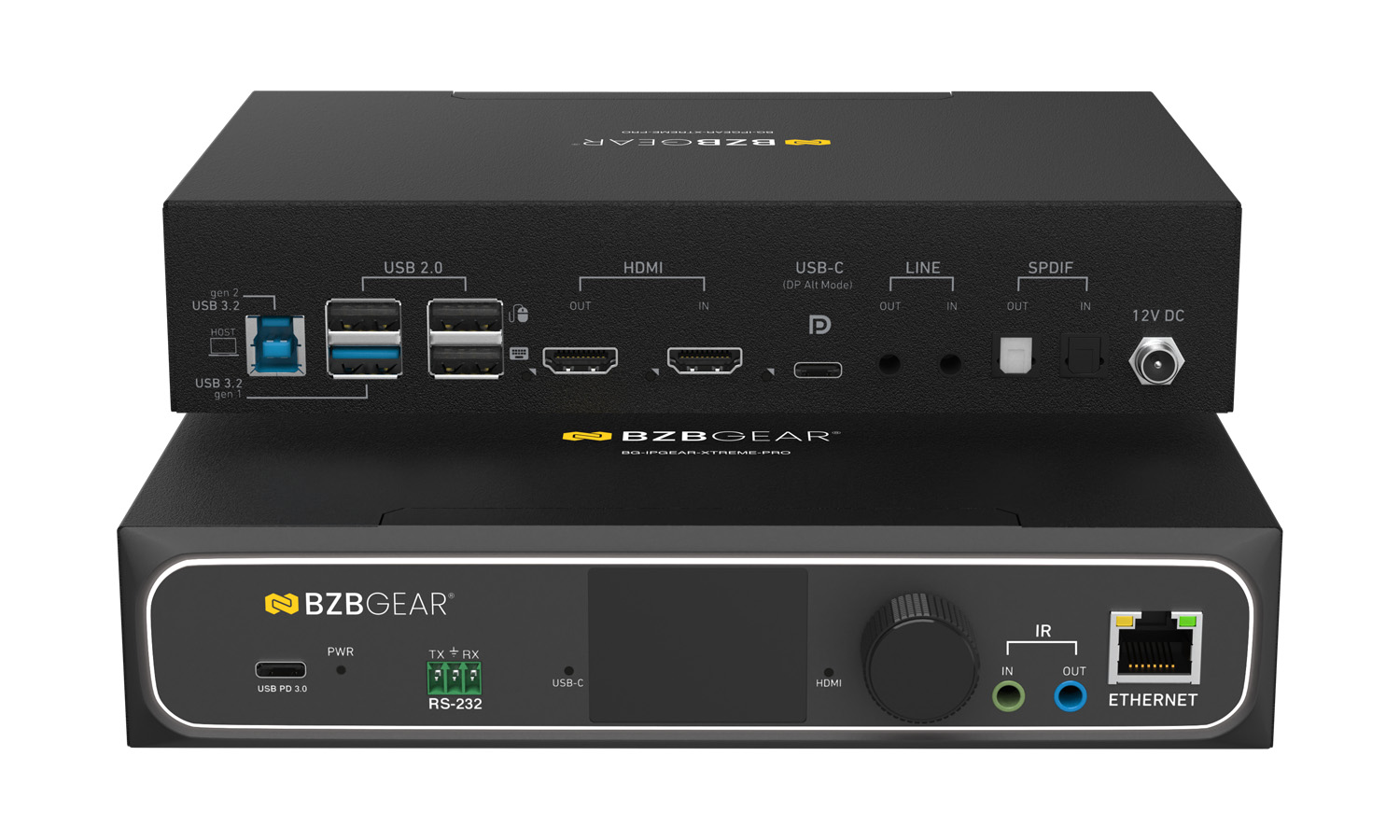
Now, remember that trade-off we mentioned — where AV over IP asks more of your network? That's the very thing BZBGEAR's XLink-ONE series is designed to soften. XLink-ONE is a step-up AV-over-IP platform that delivers up to 8K resolution with less than one frame of latency — yet it runs on the standard 1-Gigabit network most buildings already have, instead of forcing an expensive 10-Gigabit overhaul. The BG-IPGEAR-XTREME-W is a tidy 4K wall-plate encoder/decoder that pushes 4K@120Hz 4:4:4 up to 100m over ordinary Cat5e, with matrix switching, multiview, and KVM built in. When you need to go all the way to 8K, the BG-IPGEAR-XTREME-PRO is an all-in-one transceiver (transmitter and receiver in one box) that handles 8K@60Hz and 4K@144Hz with video wall and KVM support. Both give you high-end image quality and responsiveness without asking your IT team to rebuild the network to get there.
You Don't Have to Pick Just One
Here's something worth remembering: it's not always either/or. Some of the best-designed systems use HDBaseT inside each room — clean, simple, and instant — and AV over IP to tie all the rooms together. You get low-latency simplicity where the action happens and network-wide flexibility everywhere else. Pick the right tool for each layer, not one tool for the whole building.
The Bottom Line
HDBaseT is the right fit when the system is contained, the layout is set, and you want maximum simplicity with flawless performance. AV over IP is the right fit when the system needs to scale, stretch across distance, or evolve down the road. Neither one is "better" — they're built for different jobs.
If you're trying to figure out which side of that line your next project falls on, reach out. Here at BZBGEAR, we're happy to help you spec the right mix of HDBaseT and AV over IP gear for the job. To explore the full lineup of signal distribution solutions, visit BZBGEAR.com.


8.00 a.m. - 5.00 p.m. (PST)
10.00 a.m. - 3.00 p.m. (PST)
(by appointment only)