







TAA-Compliant AV Equipment: A Procurement Guide for Government Projects
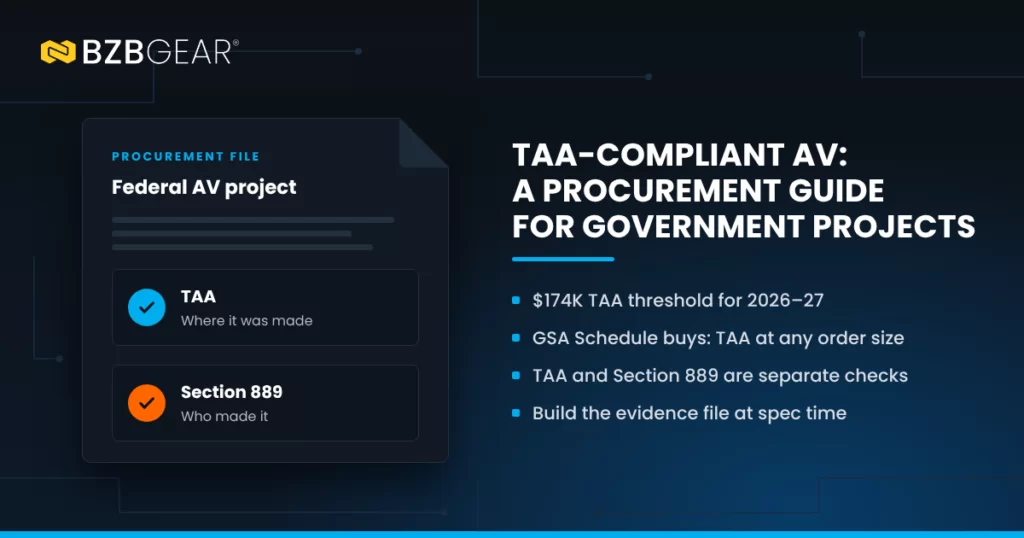
What to verify, what to document, and the compliance rule that catches AV integrators who did everything else right.
We've written before about designing a TAA-compliant signal chain without giving up performance. This article is about the other half of the job — the part that happens at the procurement desk rather than in the rack.
Because here's a pattern we see a lot: an integrator picks compliant gear, wins the bid, and then loses two weeks to a procurement review asking questions nobody prepared for. Which rule applies at this contract value? Where's the country-of-origin documentation? Is this camera also on the other list?
Let's break it down.
One note before we start: this is practical guidance from the manufacturer's side of the table, not legal advice. Your contracting officer and your counsel have the final word on any specific procurement.
First, Know Which Rule You're Actually Under
A lot of confusion clears up once you realize the Trade Agreements Act (TAA) isn't the only domestic-sourcing rule in federal buying. It's the one that applies above a dollar threshold.
Below that threshold, the Buy American Act (BAA) generally controls. BAA is a domestic preference with a content test — it doesn't bar foreign products outright. Above the threshold, TAA takes over, and it works completely differently. TAA is an eligibility rule. There's no content percentage. A product has to be manufactured or "substantially transformed" in the United States or a designated country, and if it isn't, it's out.
Think of BAA as a thumb on the scale and TAA as a locked door.
For 2026 and 2027, the World Trade Organization Government Procurement Agreement (WTO GPA) threshold for supplies and services is $174,000. It took effect January 1, 2026, and was written into the Federal Acquisition Regulation (FAR) on March 13, 2026. Several free trade agreements kick in lower: $105,767 for Australia, Chile, Colombia, Singapore, CAFTA-DR and USMCA-Mexico, $100,000 under the Korea FTA, and $50,000 under the Israeli Trade Act. The binding table lives at FAR 25.402(b), and these numbers reset roughly every two years — so check it rather than trusting a figure you read once (including this one).
The exception that matters most in AV: products sold through the GSA Multiple Award Schedule must be TAA compliant regardless of order size. That's why a $400 splitter can stall a federal order. On a Schedule buy, the threshold logic doesn't rescue you.
The Rule That Catches People: TAA Isn't NDAA
If you take one thing from this article, take this.
A product can be fully TAA compliant and still be prohibited.
Section 889 of the FY2019 National Defense Authorization Act (NDAA) restricts covered telecommunications and video surveillance equipment from five named companies — Huawei, ZTE, Hytera, Hikvision and Dahua — plus their subsidiaries and affiliates. It works in two parts. Part A bars agencies from buying covered equipment. Part B is broader: it bars agencies from contracting with any company that uses covered equipment, whether or not it touches the federal job. In the FAR, these show up as clauses 52.204-24, 52.204-25 and 52.204-26, and similar language applies to federal grant recipients under 2 CFR 200.216 — which pulls in a lot of state, local and education projects running on federal money.
Two things make this genuinely tricky in AV.
First, it's a camera-heavy rule in a camera-heavy industry, and the restriction follows the equipment, not the logo on the front panel. A rebadged product doesn't become clear just because a different name is printed on it.
Second, the two tests don't overlap the way people assume. TAA asks where something was made. Section 889 asks who made it. Passing one tells you nothing about the other. On a federal job, the safe posture is to source products that are both TAA-eligible and 889-clear, and to get each answer in writing as its own statement.
Ask every manufacturer — us included — for both. If a vendor answers an 889 question with a TAA answer, keep asking.
Build Your Evidence File at Spec Time, Not Audit Time
Compliance isn't only about buying the right thing. It's about being able to show you bought the right thing, months later, to someone who wasn't in the room.
Four things worth collecting while you spec, rather than reconstructing under a deadline:
- Written country-of-origin declarations for every line item. Not a marketing page — a document from the manufacturer naming the product and its origin.
- A complete FAR 52.225-6 Trade Agreements Certificate where the solicitation calls for one, listing every product and its origin. Blank or partial entries are where exposure starts.
- Substantial-transformation backup for anything with a complicated supply chain. For borderline calls, a manufacturer affidavit describing the transformation — or a U.S. Customs and Border Protection (CBP) ruling — is what holds up.
- Records organized by SKU, so a question about one part number doesn't mean re-auditing the whole project.
Audit the Whole BOM, Not the Headline Products
The classic mistake is treating compliance as a camera problem. It isn't. Every line on the purchase order is a checkpoint, and the items that fail review are almost never the flagship.
Walk the bill of materials (BOM) and confirm origin for each layer:
- Distribution — encoders, decoders, matrix switchers, extenders, video wall processors. This is the layer that fails review most often, mostly because it gets specified last.
- Control — production switchers, joystick controllers, control processors. It's easy to swap in a familiar non-compliant unit late in a project.
- Verification — test pattern generators and signal analyzers. Often bought separately, sometimes by the agency's own tech team, and nobody's compliance responsibility until suddenly it is.
- Accessories — SFP modules, mounts, brackets. If it's a line item, it's in scope.
Here's a simple habit that pays off: add a compliance-status column to the BOM, fill it in at spec time, and note the source for each entry. It takes about an hour, and it's the document that answers most review questions without a phone call.
BZBGEAR Highlight: Covering the Layers That Get Missed
Our full TAA Compliant Products list is published openly — AV-over-IP, cameras, joystick controllers, streaming encoders, SDI and HDMI conversion and capture, fiber and HDBaseT extension, matrix switching, video wall processing, test and verification tools, and even the SFP modules. Since the earlier article covered the headline gear, here are three examples from the layers that tend to slip through:
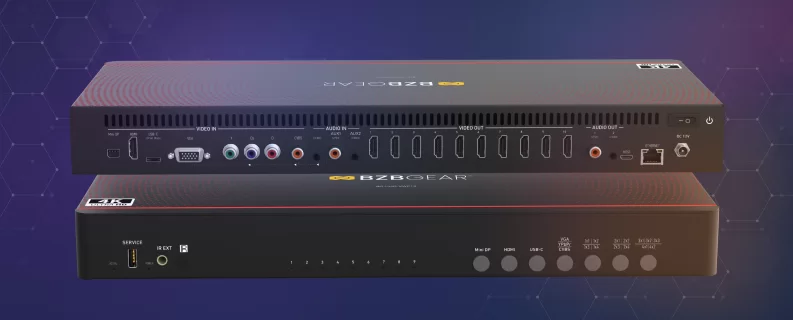
- Display distribution: the BG-UHD-VWP19 is a 4K60 video wall processor with nine HDMI outputs for walls up to 3×3, plus inputs for HDMI, DisplayPort, USB-C and legacy analog sources — a natural fit for operations centers and briefing rooms.
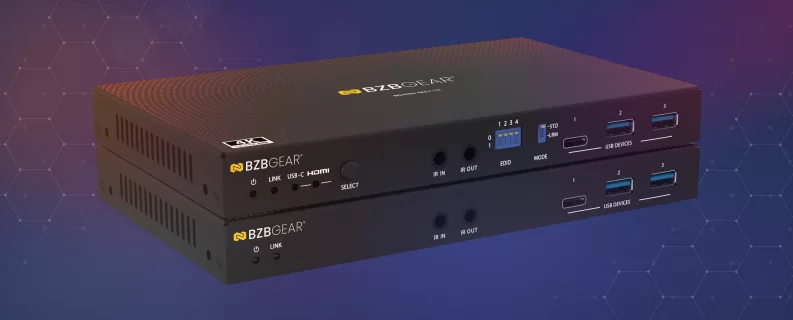
- Extension and KVM: the BG-EXH-4KC7 is an HDBaseT 3.0 extender that carries 4K60 HDMI or USB-C video, USB and Ethernet up to 100 meters over Cat6A/7 — so the computer can live in a secure closet while the keyboard and display stay at the desk.
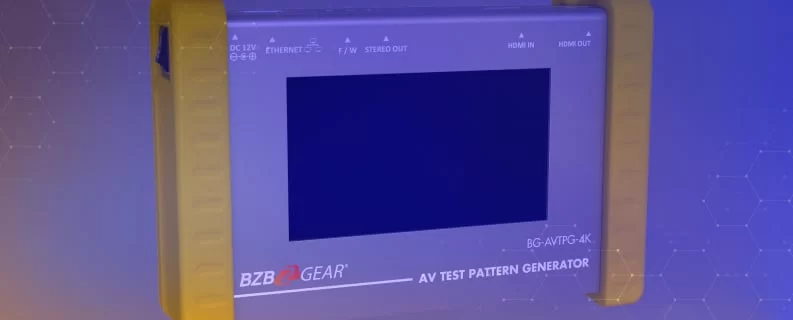
- Verification: the BG-AVTPG-4K is an HDMI 2.0 test pattern generator and analyzer with EDID reading, HDCP testing and cable testing built in. It's exactly the kind of tool that ends up on a separate purchase order — and needs to be compliant too.
The Bottom Line
Most TAA problems on AV projects aren't sourcing problems. They're documentation problems found late, or a second rule nobody checked.
So: confirm which rule your contract value puts you under, remember that GSA Schedule buys are compliant-only at any size, treat TAA and Section 889 as two separate questions with two separate answers, and build your evidence file while you're specifying — not after somebody asks.
Scoping a federal, state or DoD project and want a second set of eyes on the BOM before it goes to procurement? Reach out — we work through this with integrators regularly. And to browse everything on the list, visit bzbgear.com/taa-compliant.


8.00 a.m. - 5.00 p.m. (PST)
10.00 a.m. - 3.00 p.m. (PST)
(by appointment only)