







AV over IP vs HDBaseT: Which Technology Is Right for Your Next Installation?
A question we get all the time from integrators planning a new build: should I run this system over HDBaseT, or go full AV over IP? And that's a fair question to wrestle with. Both technologies move high-quality video and audio from point A to point B over a humble Ethernet cable, but they go about it in very different ways — and picking the wrong one can mean either overspending on a network you didn't need, or boxing yourself in when the system needs to grow.
The good news is, there's no universal right answer. There's only the right answer for your project. Let's break it down.
What HDBaseT Actually Does

HDBaseT is a point-to-point transmission technology. You take an HDMI source (a media player, a laptop, a camera), feed it into a transmitter, run a single Cat6 or Cat6a cable to a receiver on the other end, and out the other side comes your HDMI signal — often hundreds of feet later — along with audio, control signals (IR, RS-232, CEC), Ethernet, and sometimes USB and power.
Think of HDBaseT as a really, really long HDMI cable that happens to use network cabling. It uses an Ethernet cable as the physical transport, but it does not use your network. The signal travels dedicated, end-to-end, with no switches or IP addresses in the middle.
That's its biggest strength. Because the signal isn't fighting for bandwidth with anything else, HDBaseT delivers rock-solid 4K@60Hz video with effectively zero latency and visually lossless quality. It just works. For a conference room with a laptop at one end and a display at the other, or a 4x4 matrix in a small auditorium, HDBaseT is hard to beat.
What AV over IP Brings to the Table
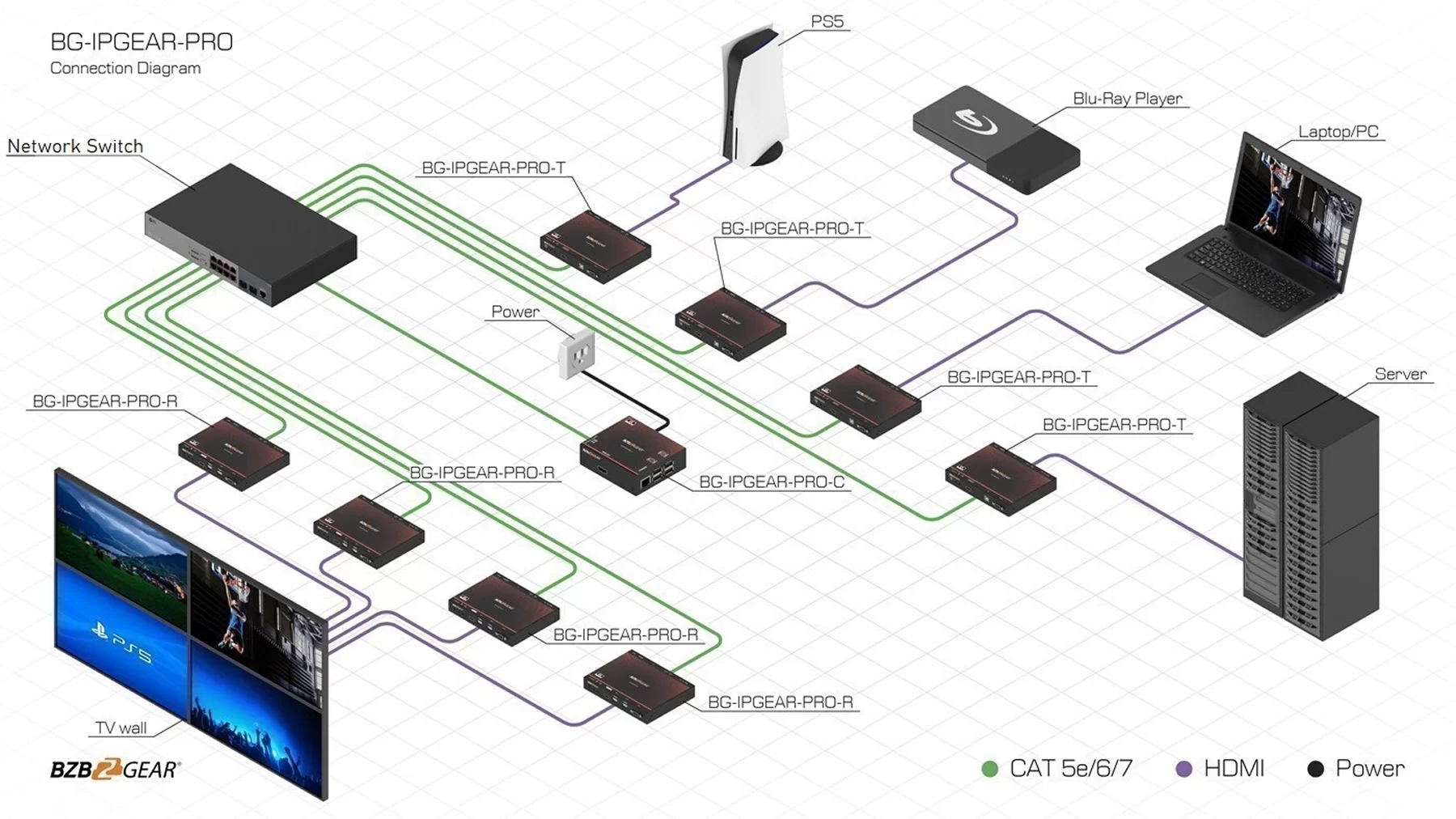
AV over IP (AVoIP) takes a different approach. Instead of a dedicated cable between every source and every display, it puts your video onto a standard IP network using encoders and decoders. Any encoder can talk to any decoder on the network, and you can mix, match, and route signals through a network switch the same way you'd route data packets.
This is where the magic — and the complexity — kicks in. A 32-source, 64-display system over HDBaseT means a 32x64 matrix switcher, which gets expensive fast. The same system over AV over IP just means 32 encoders, 64 decoders, and a properly configured switch. Want to add another display next year? Plug in another decoder. Want to feed a video wall, multiview, or KVM workstation from anywhere in the building? AV over IP handles it natively.
The trade-off is that the network becomes part of the AV system. That means VLANs, multicast configuration, IGMP snooping, jumbo frames, and a switch that can actually keep up. It's powerful, but it asks more of whoever's setting it up.
The Real Differences That Matter
So how do you actually choose between them? Here are the factors that move the needle on most projects.
Scale and flexibility. HDBaseT scales linearly — every source and display added means more matrix ports and more cable runs from the rack. AV over IP scales like a network: add a port, add a device. For systems that will grow, change, or shuffle endpoints around, AVoIP wins easily.
Distance. Standard HDBaseT (Spec 2.0 and 3.0) tops out at 100m (328ft) for 4K@60Hz over Cat6/6a, with long-range variants pushing distances out to 150m (492ft) at 1080p. AV over IP can extend as far as your network reaches — across a building, between buildings on a campus, or really anywhere a copper or fiber run can go.
Latency. HDBaseT is functionally instantaneous. AV over IP latency depends on the codec and configuration; the best modern systems are sub-frame, but it's something to design around if you're doing live performance, KVM control, or anything where lip-sync and responsiveness matter.
Cost. For small systems (think 4x4 or 8x8), HDBaseT is usually cheaper upfront. As port counts climb past 16 or so, AV over IP starts winning on cost — and it definitely wins on cost-to-expand later.
Network demand. HDBaseT doesn't touch your IT network at all. AVoIP either needs its own dedicated AV network or a carefully segmented portion of the existing one. If your IT team doesn't want AV traffic on their switches, that's a real planning constraint.
When HDBaseT Is the Right Call
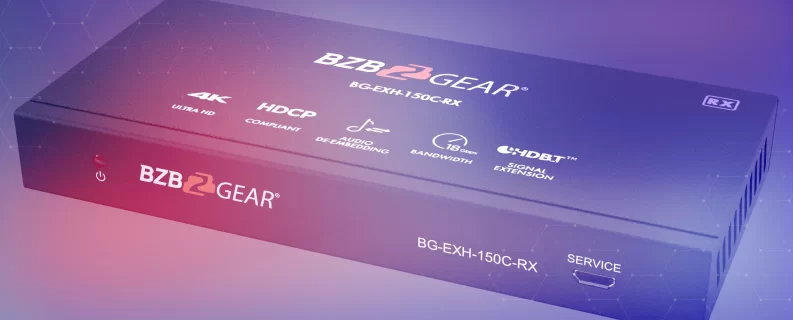
If you're outfitting a single boardroom, classroom, courtroom, or worship space where the sources and displays are fixed, the room is self-contained, and you don't anticipate the system growing dramatically — HDBaseT is usually the smarter choice. It's simpler, more predictable, and doesn't require involving your IT department. The BZBGEAR BG-EXH-150C HDMI HDBaseT extender, for example, can push 4K@60Hz up to 394ft (120m) — and 1080p up to 492ft (150m) — over a single Cat6 cable, with 18Gbps bandwidth, HDR support, and bi-directional IR, RS-232, and CEC pass-through.
For multi-display rooms that need switching, the BG-UM44-150L-KIT and BG-UM88-150L-KIT bring 4x4 and 8x8 4K@60Hz 4:4:4 HDMI matrix switching with HDBaseT extension built in, mirroring every HDMI output to an HDBaseT output so you can run sources to displays anywhere in the room without a separate extender for each one.
When AV over IP Is the Right Call
If your project spans multiple rooms, multiple floors, or an entire campus — or if the endpoint count is going to grow over time — AV over IP is almost always going to be the answer. Houses of worship with overflow rooms, sports venues with concourse displays, broadcast facilities, command-and-control rooms, video walls, and digital signage networks all play to AVoIP's strengths.
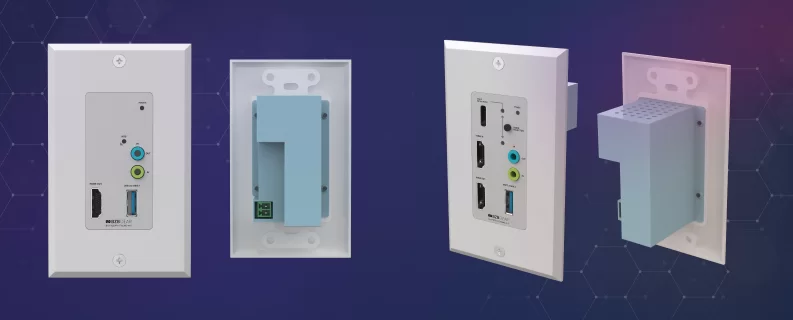
The BZBGEAR BG-IPGEAR-XTREME-W is a great example: an HDMI 2.1 over IP multicast wall plate transceiver that extends 4K@120Hz 4:4:4 up to 100m over standard Cat5e, with seamless matrix switching, multiview, KVM, USB 3.1, USB-C and DisplayPort inputs, and PoE. Drop one at every source, one at every display, and your "matrix" is whatever your network switch is.
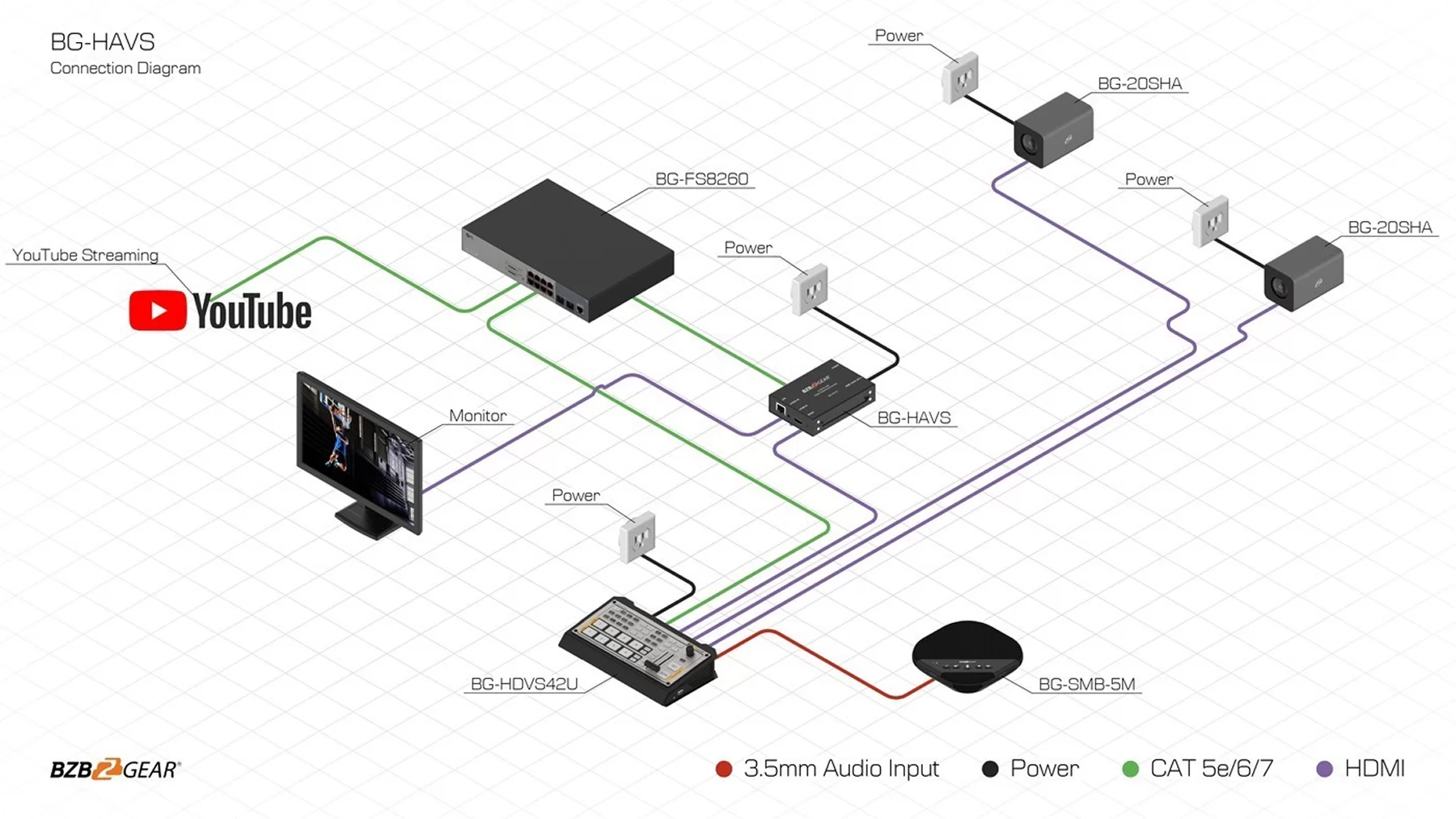
For broadcast, streaming, and Dante AV-H workflows, the BG-STREAM family covers the rest of the IP picture — BG-STREAM-E for HDMI-to-IP encoding, BG-STREAM-D as a PoE decoder back to HDMI 2.0, and BG-STREAM-DE as a single-box SDI/HDMI encoder/decoder/recorder. All support H.264/H.265 with RTSP, RTMP, HLS, SRT, NDI, and Dante AV-H — useful when you want to live-stream or record the same content you're routing on-prem.
You Can Use Both
Here's something worth remembering: it doesn't have to be either/or. A lot of well-designed systems use HDBaseT inside a room (clean, simple, low-latency) and AV over IP between rooms (flexible, scalable, network-friendly). Pick the right tool for each layer of the system, not for the whole project.
The Bottom Line
HDBaseT is the right answer when the system is self-contained, the layout is fixed, and you want maximum simplicity and zero-latency performance. AV over IP is the right answer when the system needs to scale, span distance, or evolve over time — and when you have (or can build) the network to support it.
If you're trying to figure out which side of that line your next install falls on, reach out — we're happy to help you spec the right combination of HDBaseT and AV-over-IP gear for the job. To explore the full lineup of BZBGEAR signal distribution solutions, visit BZBGEAR.com.


8.00 a.m. - 5.00 p.m. (PST)
10.00 a.m. - 3.00 p.m. (PST)
(by appointment only)