





12X, 20X, 30X, or 40X: How Much PTZ Camera Zoom Do You Actually Need?
One of the questions I get most often when someone is shopping for a PTZ camera isn't about resolution or outputs. It's "which zoom should I get?" And that's okay! The numbers on the spec sheet look like a simple "bigger is better" ladder, so it's tempting to grab the highest one you can afford and call it a day.
Here's the thing: more zoom isn't automatically better. The right lens depends on how far the camera sits from your subject, how tight you want the shot, and how wide you need to go when you pull back. Let's break it down.
What "12X" Actually Means
The zoom number is a ratio, not a distance. A 12X lens means the longest focal length is 12 times the shortest one. It doesn't tell you how far the camera can "see." It tells you the range between the camera's widest view and its tightest view.
Think of it like the gears on a bike. Two bikes can both have 12 gears, but where those gears start and end is what decides how they actually ride. That's why you'll want to look at the field of view (FOV) in degrees, not just the zoom number. The FOV at the "tele" (fully zoomed) end tells you how tight a shot you can get, and the FOV at the "wide" end tells you how much of the room you can see when you're zoomed all the way out.
One more quick note: always compare optical zoom. Optical zoom uses the lens itself to magnify the image, so detail is preserved. Digital zoom just enlarges the pixels you already have, which softens the picture fast.
The Distance Math (Made Simple)
Here's where it gets useful. Using published lens specs, you can figure out how wide the frame will be at any distance. For the numbers below, I used the field-of-view figures from the BZBGEAR BG-ADAMO-JR, which is offered with 12X, 20X, and 30X lenses.
A tight head-and-shoulders shot of a speaker is roughly 3 feet wide. A waist-up shot that leaves room for gestures is closer to 6 feet. So how far back can each lens sit and still get those shots?
|
Lens |
Tightest FOV (horizontal) |
Head-and-shoulders (≈3 ft frame) |
Waist-up (≈6 ft frame) |
|---|---|---|---|
|
12X |
6.57° |
up to ~26 ft |
up to ~52 ft |
|
20X |
3.45° |
up to ~50 ft |
up to ~100 ft |
|
30X |
2.14° |
up to ~80 ft |
up to ~160 ft |
Distances are approximate and calculated from published horizontal FOV at full zoom.
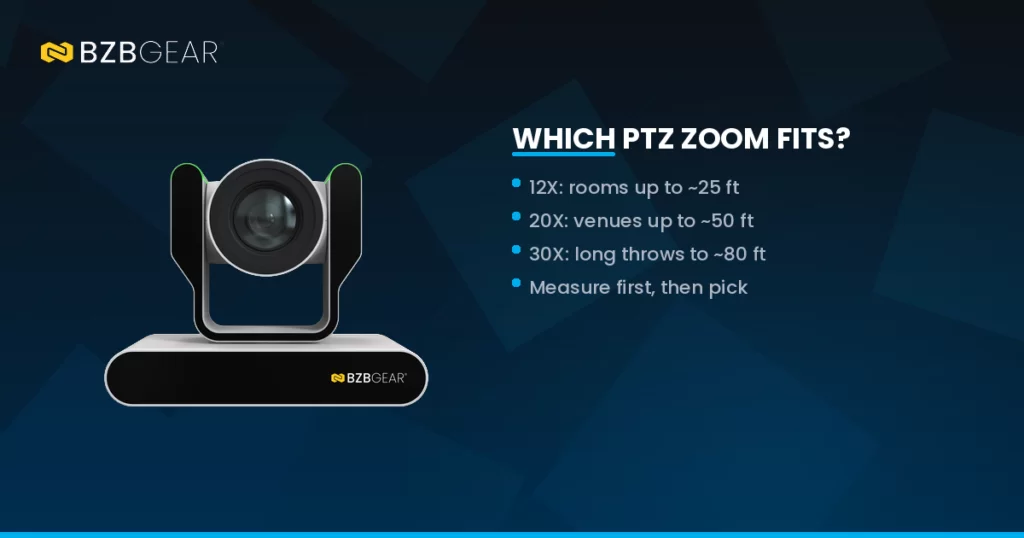
So the real question isn't "how much zoom do I want?" It's "how far will my camera be from the person I'm shooting?" Measure that distance first, and the lens choice usually picks itself.
12X: Conference Rooms, Classrooms, and Studios
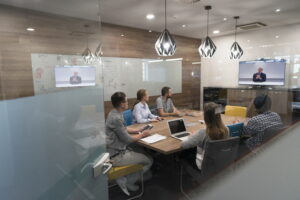
If your camera is within about 25 feet of your subject, 12X is often the sweet spot. Conference rooms, lecture halls, podcast studios, and small chapels all tend to fall in this range.
There's a bonus here that people overlook: a 12X lens usually has the widest view at the short end. On the ADAMO-JR, the 12X lens opens up to about 70° horizontally, compared to about 58° on the 30X. In a tight room where the camera is only 10 feet from the table, that's the difference between getting everyone in frame or cutting off the people on the ends.
20X: Mid-Size Sanctuaries, Auditoriums, and Gyms
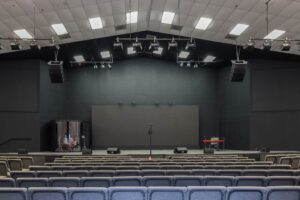
Once the camera moves to the back of a mid-size space, somewhere in the 25–50 foot range, 20X starts to earn its keep. This is the most common sweet spot for houses of worship, school auditoriums, and multipurpose rooms.
A 20X lens gives you a clean close-up of the pastor or presenter from the back wall, while still pulling wide enough for a full stage shot. For a lot of venues, it's the "do-everything" choice.
30X: Large Venues and Long Throws
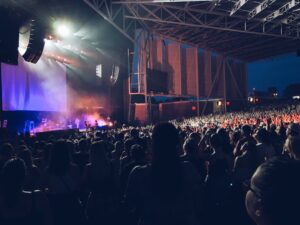
If your camera position is 50 feet or more from the stage, or you want really tight shots from a mid-distance, 30X is where you'll land. Large sanctuaries, arenas, convention halls, and sports venues are typical 30X territory.
Keep in mind that the longer the lens, the more every tiny movement is magnified. At full 30X zoom, a little vibration from a wobbly mount or foot traffic on a balcony shows up on screen. Mount long-zoom cameras on something solid, and you'll be glad you did.
What About 40X?
40X lenses exist for genuinely long throws: think large arenas, stadium-scale events, and outdoor coverage where the camera may sit well over 100 feet from the action. If you need a tight close-up from across a basketball arena or the far end of a convention center, that's when 40X starts to make sense.
For most indoor installs, though, 40X is more lens than you need. You'll be using a small slice of its range, giving up some width at the short end, and working harder to keep the shot steady. If your measured distance comes in under about 80 feet, a 20X or 30X lens will usually serve you better.
BZBGEAR Highlight: Matching the Lens to the Room
The BZBGEAR BG-ADAMO-JR is a good example of why zoom options matter. It's a 1080p@60Hz PTZ camera with AI auto-tracking and built-in tally lights, and it's available with a 12X, 20X, or 30X lens, so you can match the camera to the room rather than the other way around. It also outputs over HDMI, 3G-SDI, USB, and IP, with NDI|HX3 and Dante AV-H versions available.
If your production calls for 4K, the BZBGEAR BG-ADAMO-4K comes in 12X and 25X lens options. The 25X version covers most of the same mid-to-large venues as a 20X or 30X lens, with UHD resolution on top.
A Quick Checklist Before You Buy
- Measure the distance from your planned camera position to the subject.
- Decide on your tightest shot (head-and-shoulders, waist-up, or full body).
- Check the wide end, too, especially in small rooms.
- Plan a solid mount for anything 20X and up.
- Think about future use. If the camera might move to a bigger room, a step up in zoom gives you headroom.
The Bottom Line
At the end of the day, the right zoom is the one that fits your room. Measure first, think about the shots you actually need, and let the field of view do the deciding. Most conference rooms and classrooms live happily at 12X, most sanctuaries and auditoriums at 20X, and big venues at 30X and beyond.
Still not sure which lens fits your space? BZBGEAR offers free project design consultations, and our team will help you pick the right lens based on your room's dimensions. Explore the full lineup of BZBGEAR PTZ cameras, or reach out and let us help you get it right the first time!


8.00 a.m. - 5.00 p.m. (PST)
10.00 a.m. - 3.00 p.m. (PST)
(by appointment only)