





Dante AV-H vs. NDI HX3 vs. SDI: Choosing the Right PTZ Camera Workflow
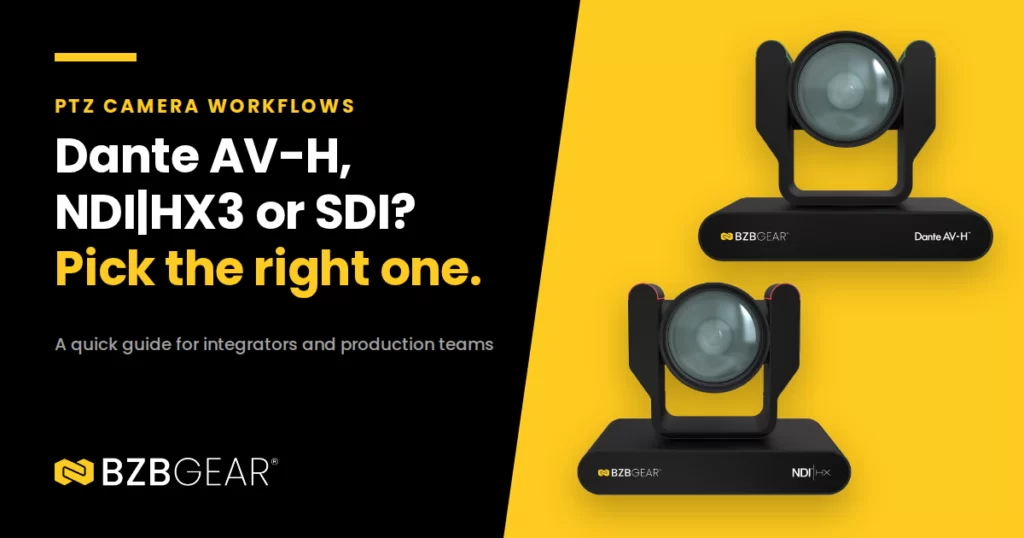
A question I get a lot when someone is speccing PTZ cameras goes something like this: "Should I go NDI, Dante, or just run SDI?" And that's okay! Five years ago the answer was usually "run SDI and call it a day." Today you've got three solid options, and each one fits a different kind of room.
The good news is you don't have to guess. The right workflow usually comes down to what's already in your rack and who's going to run the system day to day. Let's break it down.
First, What's Actually Different?
All three get video out of the camera and into your switcher. The difference is how the signal travels and what it brings along for the ride.
Serial Digital Interface (SDI) is a dedicated coax cable carrying uncompressed video from one point to another. One camera, one cable, one input on your switcher. Camera control usually rides on a separate serial line (VISCA over RS-232 or RS-422).
NDI|HX3 (Network Device Interface) sends compressed video over your regular Ethernet network using H.264 or H.265. Any NDI-capable switcher, software or monitor on that network can find the camera and pull its feed. The NDI protocol can also carry tally and PTZ control alongside the video and audio, so much of the system rides on the same network.
Dante AV-H does something similar, also using H.264/H.265 over standard Gigabit networks. The twist is that it's built on Dante, the audio networking platform already running in a huge number of churches, conference centers and performance venues. Your camera shows up in Dante Controller right next to your mics and DSPs.
Think of it this way: SDI is a private road between two buildings. NDI and Dante AV-H are both the city street grid. They just use different traffic systems.
SDI: The Dedicated Line
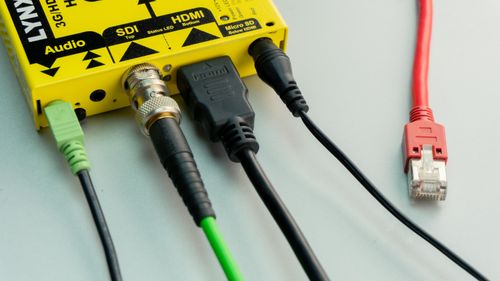
SDI has been the backbone of broadcast for decades, and for good reason. It's uncompressed, it's point-to-point, and there's no network to configure. Plug it in and it works.
That simplicity is also its biggest strength when things go wrong. There's no IP address to chase down or switch setting to check. If there's a problem, it's the cable, the connector or the device.
Where SDI shines:
- Broadcast trucks, flypacks and facilities already built around SDI routers and switchers
- Live productions where the video path absolutely cannot share bandwidth with anything else
- Crews who want the most predictable, lowest-latency path possible
The trade-off: every camera needs its own home run of coax, plus control and power. Add a few PTZs spread around a large room and that cable count adds up fast. Distance is limited too, especially at 12G-SDI for 4K, so longer runs typically need fiber conversion.
NDI|HX3: The Software-Friendly Network Option
NDI has become the go-to for streaming-focused productions. If your switcher is software like vMix, OBS or a TriCaster, or you're mixing cameras with laptops, graphics machines and remote guests, NDI makes all of them look like sources on the same network.
HX3 is the current generation of the compressed NDI|HX family. Compared to HX2, it delivers better image quality and lower latency, while still being efficient enough for a standard Gigabit network. That balance makes it a natural fit for PTZ cameras.
Where NDI|HX3 shines:
- Streaming studios, esports and content creator setups
- Houses of worship running software-based production
- Anywhere you want to add a camera by plugging it into a network switch instead of pulling a new cable to the booth
The trade-off: it's compressed video, and your network matters. Make sure your switches are properly configured, and check that your production software or hardware supports HX3 specifically, not just older NDI versions.
Dante AV-H: When Your Audio Team Already Speaks Dante

Here's the thing about Dante AV-H. Its biggest advantage isn't the video codec. It's the fact that your video joins an ecosystem your audio team already knows.
If a venue runs a Dante audio network, the A1 is already routing mics, consoles and amplifiers in Dante Controller. With Dante AV-H cameras, they can route video the same way, with audio and video kept in sync and managed from one familiar tool. For larger or IT-managed sites, Dante Domain Manager adds user permissions and network segmentation on top.
Where Dante AV-H shines:
- Houses of worship, conference centers and theaters with an existing Dante audio system
- Corporate and education campuses where IT wants centralized, managed AV
- Integrators who want one network platform for both audio and video
The trade-off: you'll want Dante-aware receivers or decoders on the other end. If your production switcher only speaks NDI or SDI, you'll need a bridge in between.
So, Which One Should You Choose?
A few quick questions usually settle it:
|
If your setup looks like this… |
Start with |
|---|---|
|
SDI switcher or router already in place, crew wants zero surprises |
SDI |
|
Software-based production, streaming-first, lots of network sources |
NDI|HX3 |
|
Existing Dante audio network, audio team runs the system |
Dante AV-H |
|
A mix of all of the above |
A camera that does both |
That last row matters more than you'd think. Plenty of real-world systems are hybrids: SDI to the main switcher for the program feed, and an IP stream to a streaming PC, overflow room or recording system at the same time.
BZBGEAR Highlight: One Camera Family, Every Workflow
This is exactly why the BZBGEAR BG-ADAMO-4K series comes in three versions. The standard model covers SDI, HDMI and streaming protocols like SRT and RTMP. The BG-ADAMO-4KND adds NDI|HX3, and the BG-ADAMO-4KDA adds Dante AV-H.
Every version keeps 12G-SDI and HDMI outputs at up to 4K@60Hz, so choosing an IP flavor never means giving up your baseband feed. You also get AI auto-tracking, red/green LED tally lights and 12X or 25X optical zoom.
Need HD coverage for the rest of the room? The BG-ADAMO-JR series follows the same pattern at 1080p@60Hz, with NDI|HX3 and Dante AV-H versions and the same control workflow.
At the End of the Day
There's no single "best" PTZ workflow. SDI gives you rock-solid simplicity. NDI|HX3 gives you software flexibility. Dante AV-H gives you one platform for audio and video. The right answer is the one that fits the system you already have and the people who'll run it.
And if you're not sure which camp your project falls into, that's what we're here for. Reach out to the BZBGEAR team with your system layout, and we'll help you map out the workflow that makes sense. To explore the full lineup of PTZ cameras, visit BZBGEAR.com.


8.00 a.m. - 5.00 p.m. (PST)
10.00 a.m. - 3.00 p.m. (PST)
(by appointment only)