







4K vs. 8K HDMI Matrix: What Actually Matters in 2026?
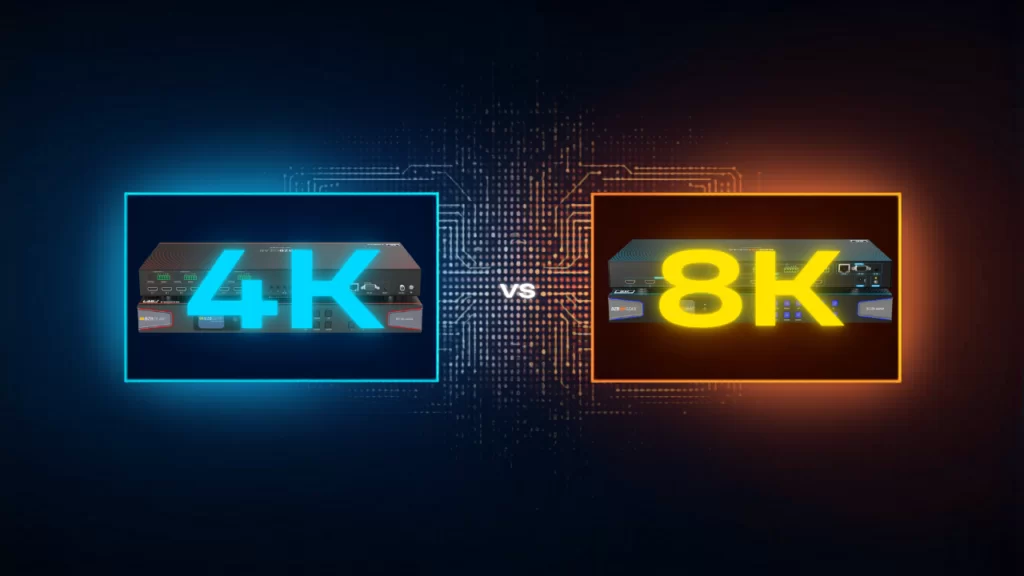
If you've shopped for an HDMI matrix switcher in the last year, you've probably noticed something — "8K" is now showing up on spec sheets. It's stamped on boxes, plastered across landing pages, and sprinkled through datasheets like seasoning. So a question we get all the time at BZBGEAR is a fair one: does my next install actually need 8K, or is the 4K matrix I've been spec'ing for years still the right call?
Let's break it down.
When 8K Is Real vs. When It's Marketing Fluff
To save you some time and put it up front — for most installs in 2026, 8K is still more about future-proofing than today's content.
True 8K (7680 x 4320) is genuinely available in a few places. The latest gaming consoles can output 8K signals. High-end cinema cameras and broadcast workflows shoot 8K for downsampling and reframing. A handful of streaming platforms have 8K demo content, and the medical imaging and AV-over-IP simulation worlds are pushing into 8K for very specific reasons. That's all real.

What's not real is most of what people watch. Live sports, cable broadcasts, conferencing platforms, the vast majority of streaming services — still 1080p or 4K (although some sports are being streamed in 8K). So if your client is asking for an 8K matrix because their boardroom display has "8K" on the bezel, the practical question is: what 8K source is going to feed it?
The honest answer? An 8K matrix in 2026 is the smart choice when:
- You're installing into a space that will be re-spec'd in 5+ years and you don't want to rip and replace
- Your client uses high-frame-rate 4K (4K120) for esports, gaming lounges, or simulation
- You're mixing future 8K sources with current 4K displays and need clean auto-downscaling
- HDR, VRR, ALLM, and other HDMI 2.1 features matter to the experience right now
For everything else — most corporate, hospitality, and worship installs — a well-built 4K HDMI 2.0 matrix still does the job and can save real money.
HDMI 2.1 vs. 2.0 — Why the Confusion Won't Quit

This is where most of the confusion in the matrix switcher world actually lives. HDMI 2.1 is not just "HDMI 2.0 plus 8K." It's a different signaling scheme with a much wider pipe and a stack of new features that matter even at 4K.
HDMI 2.0 tops out at 18 Gbps of bandwidth. That's enough for 4K at 60Hz with 4:4:4 color and HDR — which is plenty for most real-world content today. It's a mature, stable, well-supported standard.
HDMI 2.1 jumps that bandwidth to 48 Gbps. That extra headroom is what enables 8K at 60Hz, 4K at 120Hz, dynamic HDR, eARC, VRR (Variable Refresh Rate), ALLM (Auto Low Latency Mode), and Quick Frame Transport. If any of those acronyms matter to your install — gaming lounges, esports rooms, premium home theaters — you need 2.1 even if you'll never touch 8K resolution.
Here's the trap: a lot of "HDMI 2.1" matrix switchers on the market support some 2.1 features but not the full bandwidth or feature set. Always check the actual spec'd bandwidth, supported resolutions, and feature list — not just the version number on the box. A real HDMI 2.1 matrix should clearly state 48 Gbps support and call out the 2.1 features it implements.
Real-World Use Cases — When to Spec Which
Theory is fine, but most of these decisions come down to the room. Here's how it usually shakes out.
Sports Bars. Your sources are mostly cable boxes, streaming sticks, and the occasional in-house camera feed — overwhelmingly 1080p and 4K. Your displays are 4K TVs, often a lot of them. What you actually need is a matrix with enough I/O to fan out to every screen reliably, audio de-embedding for the bar's sound system, and rock-solid HDCP handling so a single device doesn't blank the whole wall. A 4K HDMI 2.0 matrix is almost always the right call here. Spending the 8K premium gets you nothing the customer can see.

Control Rooms. Critical-information environments — security operations, network operations, transit, utilities — care about uptime, latency, and clean video wall behavior far more than peak resolution. A seamless 4K matrix with built-in video wall processing is usually the smarter spend, because you get scaling, multiviewer modes, and rack-friendly form factors in a single box. 8K becomes interesting only when the source content is itself ultra-high-resolution — think mapping, satellite imagery, or scientific visualization.

Enterprise & Conference Rooms. Boardrooms, training rooms, and divisible spaces are dominated by laptops, conferencing codecs, and digital signage at 4K or below. An HDMI 2.0 matrix routed over HDBaseT to displays around the room handles 95% of these jobs cleanly. Where 2.1 starts to earn its keep is in executive briefing centers and innovation labs that may take in 4K120 sources from gaming PCs, simulators, or AR/VR rigs.

Esports & Gaming Lounges. This is where HDMI 2.1 stops being optional. 4K at 120Hz, VRR, and ALLM are baseline expectations for serious gaming spaces, and an 8K HDMI 2.1 matrix gives you the bandwidth headroom to handle every source without dropouts. If your project lives here, don't compromise on the matrix.

BZBGEAR Highlight — A Matrix for Every Tier
The good news is you don't have to pick between extremes. BZBGEAR builds matrix switchers across the full range so the product matches the room.
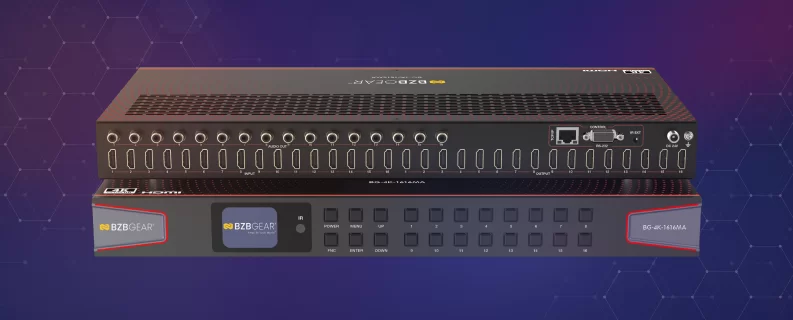
For 4K-first installs — sports bars, hospitality, conferencing — the BG-4K-1616MA delivers 4K60 4:4:4 with HDR and audio de-embedding in a proven, deployment-friendly chassis. For smaller rooms, the BG-4K-44MA and BG-4K-88MA hit the same spec at 4x4 and 8x8.
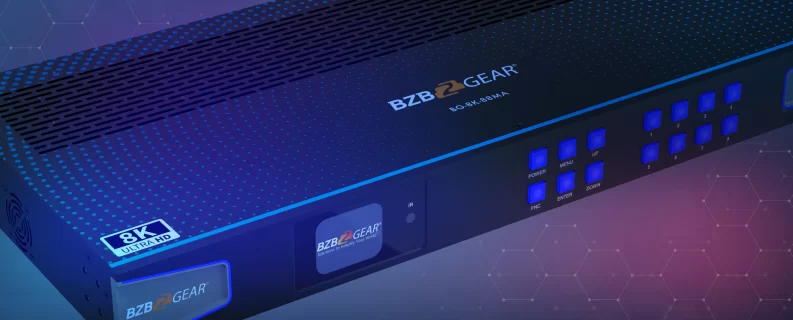
For installs that genuinely need 8K and full HDMI 2.1, the BG-8K-88MA supports 8K60, 4K120, VRR, FVA, and ALLM, with auto-downscaling so 8K sources play cleanly on 4K displays. For larger deployments, the BG-8K-1212MA and BG-8K-1616MA extend the same feature set up the chassis size.
And if your project is the kind where the requirements are going to keep evolving, the modular BG-MC Series lets you mix card types and scale from 8x8 to 36x36 without replacing the chassis.
Where to Go From Here
At the end of the day, the 4K-versus-8K matrix decision in 2026 isn't really about resolution at all — it's about matching the bandwidth and feature set to the actual sources, displays, and lifespan of your install. 8K HDMI 2.1 is the right answer for some rooms, and a great 4K HDMI 2.0 matrix is the right answer for many more.
If you're spec'ing a project and you're not sure which side of that line you're on, reach out. Here at BZBGEAR, we'd rather help you size the matrix correctly than sell you bandwidth you'll never use. Explore the full lineup of matrix switchers at BZBGEAR.com.


8.00 a.m. - 5.00 p.m. (PST)
10.00 a.m. - 3.00 p.m. (PST)
(by appointment only)