







XLink-ONE, Model by Model: Which AV-over-IP Unit Belongs in Your Rack?
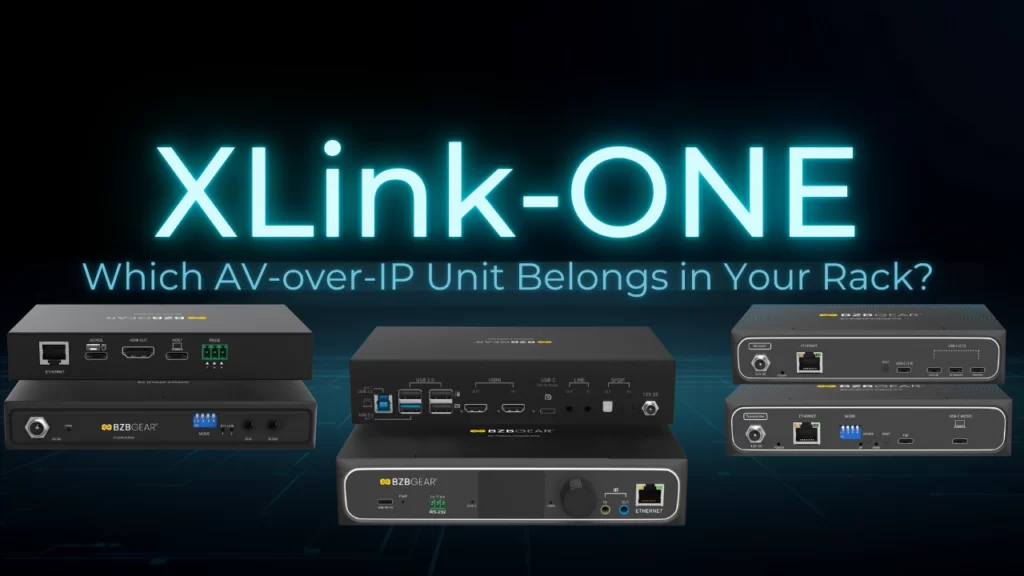
A closer look at the five endpoints in the XLink-ONE series — and the one tool that keeps you from guessing.
We recently sat down with Commercial Integrator to talk about where AV-over-IP is headed, and the conversation kept landing on the same point: the debate over whether AV belongs on the network is basically over. It does. The harder question now is how you deploy it, secure it and live with it for the next decade. You can read that conversation here: BZBGEAR Bets on Operationalizing AV-Over-IP — Not Debating It.
That article covered the philosophy. This one covers the hardware.
XLink-ONE isn't a single box — it's a family of endpoints that all speak the same language, so you can mix and match them across a job without stitching together three different platforms. But they're not interchangeable, and picking the wrong one is how a clean design turns into a change order. Let's break down what each model actually does.
What the Networked Endpoints Have in Common
Before the differences, the shared foundation. Four of the models — XTREME, CORE, W and PRO — are networked AV-over-IP endpoints. They're all HDMI 2.1 and HDCP 2.3 compliant, they all run on a standard 1 Gigabit Ethernet network, and they all deliver less than one frame of end-to-end latency. That last spec is the one that matters most in practice — sub-frame latency is what makes KVM feel like a directly connected machine instead of a remote session.
Each of them supports point-to-point, point-to-many and multicast distribution, which means the same hardware scales from a two-display huddle room to a building-wide system without a product swap. Multicast does require a managed switch with IGMP snooping, and the platform supports 802.1Q VLAN tagging so your AV traffic can live on its own segment.
Audio is uncompressed up to 7.1 channels, including Dolby TrueHD and DTS-HD Master Audio. CEC bypass and bi-directional IR and RS-232 pass-through are standard across the line, and routing is handled through the BZBGEAR Switch Control app on Windows, macOS, iOS and Android — so you don't need a separate control processor just to get a system commissioned.
And because AV endpoints on an enterprise network are still endpoints, the XLink-ONE platform builds in AES-256 encryption. As our own Matt Richards put it to Commercial Integrator, encrypted distribution is now "more of a requirement these days."
The fifth model, the fiber kit, plays by slightly different rules. We'll get to it.
BG-IPGEAR-XTREME: The Everyday Workhorse
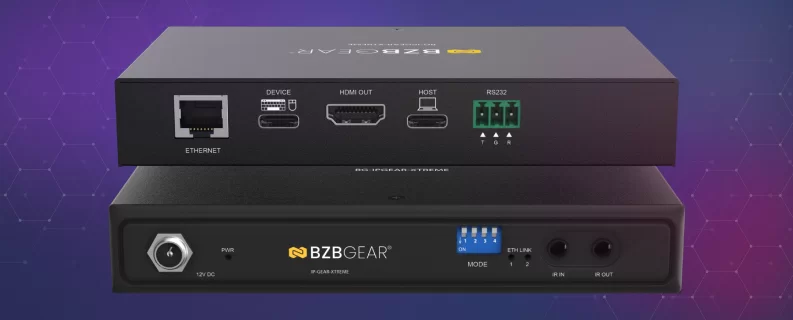
This is the one that goes in most rooms. It's a bi-directional transceiver — the same unit works as an encoder or a decoder depending on how you configure it, which is genuinely useful when you're building a spares kit and don't want to stock two SKUs.
It handles 4K@120Hz 4:4:4 at FRL 5 (40Gbps) and runs up to 100m (330ft) over Cat5e. It's PoE-capable, draws a maximum of 12 watts, and it's small — about 5.2 x 3 x 0.79 inches — so it fits behind a display or in a shallow credenza. VRR and ALLM are on board, plus USB 3.1 Gen1/Gen2 with full KVM support.
If you're specifying a conference room, a classroom or a hospitality build and you don't need 8K, start here. The single-SKU transceiver design is the quiet win — one part number covers every position in the system.
BG-IPGEAR-XTREME-CORE: The Full 48Gbps Pipe
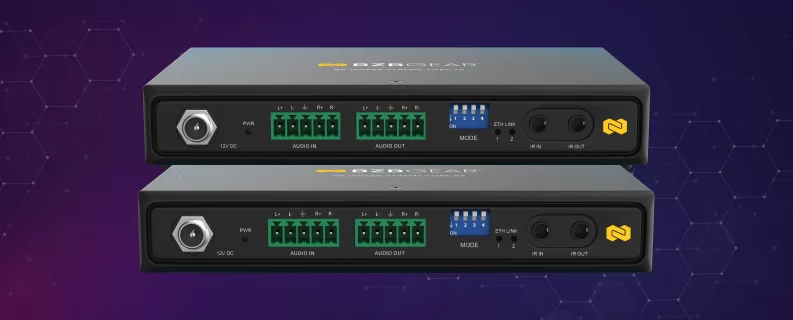
Here's the thing about the XTREME: at FRL 5, it tops out at 40Gbps. The CORE opens the full 48Gbps FRL 6 pipe at 4K@120Hz 4:4:4, over the same 100m (330ft) of Cat5e.
One structural difference worth knowing before you spec it. Unlike the XTREME, the CORE isn't a configurable transceiver — it ships as a fixed-role kit, a transmitter with HDMI in and a receiver with HDMI out. It still scales to point-to-many and multicast on a managed switch; you just can't repurpose a spare unit to whichever end needs it.
Two features earn it a spot on install day. First, Power over Cable (PoC), so the remote end doesn't need a local outlet. Second, balanced audio — and it's on both ends. Each unit carries a balanced input and a balanced output on 5-pin terminal blocks at 3.975 Vrms / 12 dBV (600Ω), which means you can embed and de-embed analog audio at either end and drop it straight into a DSP-based system without an adapter hanging off the back of the rack. It also supports eARC/ARC for pulling display audio back to a soundbar or processor.
Worth noting: the CORE has a 1GbE port carrying the AV path and a separate Ethernet pass-through for feeding a device at the far end — and that pass-through runs at 10/100 Mbps, point-to-point mode only. Plan accordingly if you were counting on it to serve a smart display.
BG-IPGEAR-XTREME-W: The Wall Plate
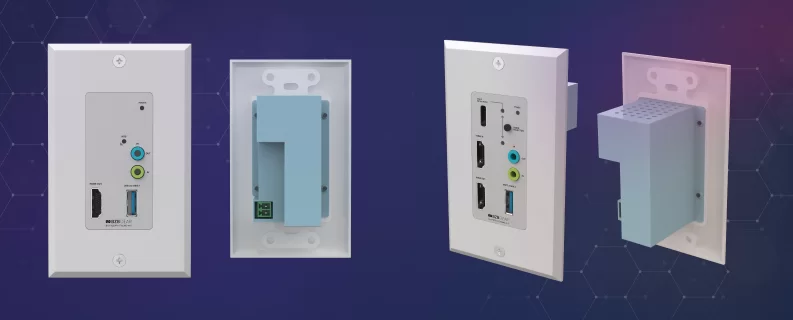
The W delivers 4K@120Hz 4:4:4 at FRL 5 (40Gbps) up to 100m (330ft) over Cat5e, with USB 3.x KVM, in a wall-plate form factor with a metal enclosure and ESD protection. Like the CORE, it's sold as fixed-role units — a transmitter and a receiver as separate part numbers — so order accordingly.
The reason to reach for this one isn't the specs, it's the aesthetics and the labor. Lecterns, huddle spaces, exam rooms and any environment where a visible box is a problem. It supports HDMI and DisplayPort 1.4 via USB-C Alt Mode, and BZBGEAR specifies it as a PoE-powered design — worth confirming the power method with your rep at spec time, since the wall-plate position is exactly where you don't want to discover you need a local outlet.
BG-IPGEAR-XTREME-PRO: The Flagship
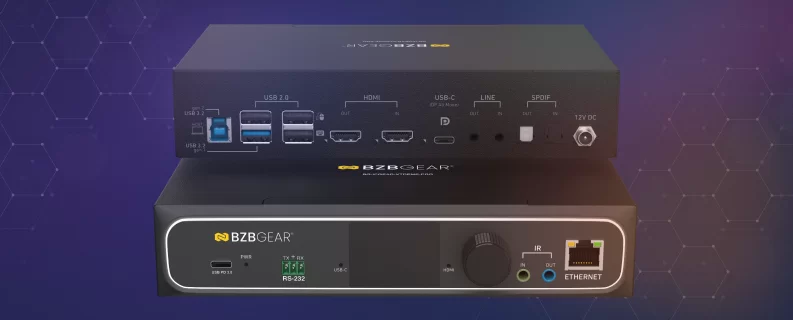
The PRO is where the ceiling comes off. It handles 8K@30 4:4:4, 8K@60Hz 4:2:0 uncompressed, 8K@60Hz 4:2:2 with DSC, and 4K@144Hz 4:4:4 — all across the same 48Gbps FRL 6 bandwidth, still on a 1GbE network, still under one frame of latency.
It's also the model with the full display toolkit. Video wall support includes image rotation and flipping, so portrait-oriented arrays and creative layouts don't require external processing. Multi-view covers PiP, PbP and PoP with chroma key. It accepts simultaneous HDMI and DisplayPort input via USB-C Alt Mode, and it can run full-duplex video at 4K@120Hz 4:4:4.
It's also the distance leader of the copper models: 170m (560ft) over Cat5e/6/6a/7, rated at 4K@144Hz 4:4:4 and 8K@60Hz 4:2:2 DSC. That's the one model where maximum resolution and maximum reach coexist.
Command centers, broadcast facilities, esports venues, operating rooms, high-end showrooms — anywhere the display wall is the deliverable. It's a metal unit at 8.7 x 4.1 x 1.7 inches. Note that unlike the XTREME and the W, the PRO is not PoE-powered — it runs on the supplied 12V DC adapter, so budget an outlet at every PRO location.
BG-IPGEAR-XTREME-F: Fiber for the Long Haul
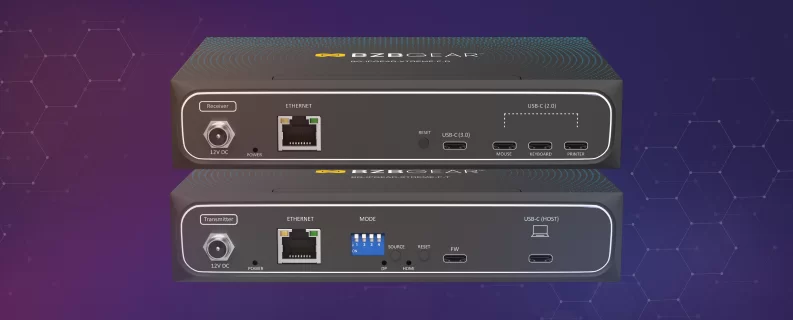
When copper runs out of road, the F takes over. Unlike the four models above, this one isn't a multicast network endpoint — it's a matched transmitter-and-receiver kit over single-mode fiber, running point-to-point up to 10km (6.25 miles). BZBGEAR specifies it at 8K@60Hz 4:4:4 DSC, uncompressed 4K@60Hz 4:4:4 and visually lossless 4K@144Hz 4:4:4, and rates it at zero-frame latency — the only model in the family described that way rather than as sub-frame.
You get full-duplex RS-232 at 115,200 bps, bi-directional IR across the 20kHz–60kHz waveband, CEC pass-through, 1Gb Ethernet pass-through and USB 3.1 Gen1/Gen2 KVM. EDID and HDCP are fully transparent rather than managed, which is the right behavior for a dedicated link. And because it's optical, it's immune to the electrical noise and ground-loop headaches that come with running copper between buildings.
This is a campus-to-campus, stadium, medical imaging and master-control product. It's a dedicated link rather than a distribution layer, so it should appear on a bill of materials when distance or interference actually demands it — not as a default.
BG-AVTPG-8K: The One That Saves the Callback
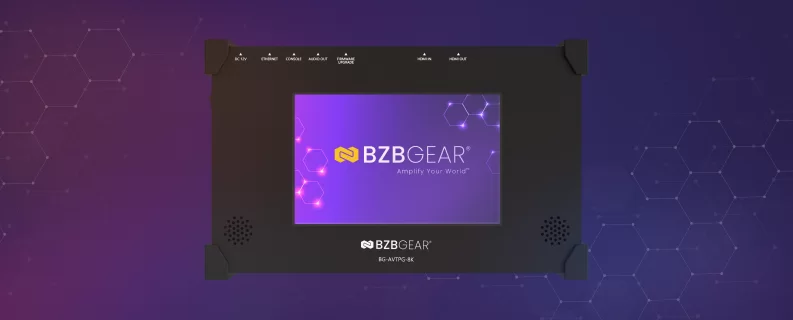
Not a distribution endpoint, but it belongs in this conversation. The BG-AVTPG-8K is an HDMI 2.1 signal generator and analyzer with a 7-inch touch screen and roughly nine hours of battery life.
It generates and analyzes signals up to 8K60 4:2:0 8-bit, 8K30 4:4:4 and 4K@120Hz, handles HDCP-encrypted content up to HDCP 2.3, measures +5V and hot-plug detect, and stores up to 4GB of user-defined patterns. On the EDID side it reads, saves and emulates — you can pull the EDID off a display, learn it onto the analyzer's input and see exactly what a source is being told. When a display isn't syncing at 4:4:4 and everyone in the room is pointing at the network, that's what tells you whether the problem is actually the source, the sink, the cable or the handshake.
How to Choose in Thirty Seconds
- Standard rooms, PoE, one part number for every position → BG-IPGEAR-XTREME
- Full 48Gbps, balanced audio into a DSP, no outlet at the far end → BG-IPGEAR-XTREME-CORE
- Clean aesthetics, lecterns and wall pockets → BG-IPGEAR-XTREME-W
- 8K, video walls, multi-view, 4K@144Hz, and the longest copper runs → BG-IPGEAR-XTREME-PRO
- Beyond copper, between buildings, high-EMI environments → BG-IPGEAR-XTREME-F
- Commissioning and troubleshooting any of the above → BG-AVTPG-8K
Because the networked endpoints share the same platform, you can put a PRO in the control room, XTREME units in the flex spaces and wall plates at the lecterns, then bridge to the building across the quad with a fiber pair — and manage the networked side as one system.
Ready to Spec It Out?
XLink-ONE took home a Best of Show award from AV Technology at InfoComm 2026, and the whole point of the platform is that it doesn't ask you to rebuild the network to earn that performance. Explore the full lineup, download the spec sheets and request a demo at xlink-one.bzbgear.com.
Working through a design and not sure which endpoint belongs where? Reach out — our team will walk the bill of materials with you before it becomes a change order.


8.00 a.m. - 5.00 p.m. (PST)
10.00 a.m. - 3.00 p.m. (PST)
(by appointment only)