







What Is AV over IP? How It Works and Why It’s Replacing Traditional AV Systems
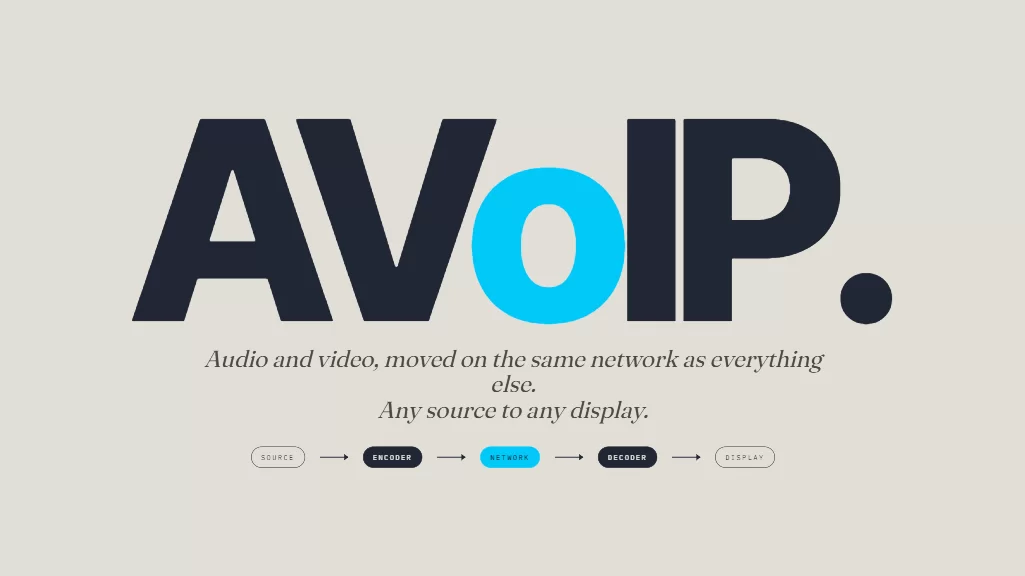
For a traditional AV design, they usually will be relying on fixed cabling and a fairly complex hardware system that isn’t always best suited to expansion. Once a space outgrows the limitations of the original matrix you’re looking at a new switcher, more wiring or more labor. But that’s where AV over IP comes in. AV over IP allows for a system to turn its video audio and control into network traffic that can move through an easily scalable backbone. For companies, schools and operation teams this means a much more flexible system with a cleaner upgrade path that is generally a smarter long-term design.
What Is AV over IP? Technology and AV over IP Meaning
So what exactly is AV over IP? To make a long story short: it’s a system that is designed to allow for sending AV signals as data packets across a standard network. For all intents and purposes this is the AV over IP meaning. However if we’d like to get more granular, we can run it down like this: a source connects to an encoder, the network carries the stream, and a decoder rebuilds the signal at the endpoint. The beauty of this system is that the network becomes the transportation medium, while management software handles routing, grouping, and control. This ends up making the whole system easier to build on as opposed to a fixed hardware matrix and ends up being more efficient for a growing deployment.
As a result, an AV network can be as simple as to support one room or become as complex as necessary to build a campus-wide network. With older designs, every extra display would mean another direct cable run and maybe even having to add another matrix. With AV over ip systems however, the same network that you use on a daily basis suddenly becomes a system that can route content to many endpoints. You’re able to build zones and adapt the system as the project grows. All of this means that at the end of the day, the system is easier to evolve and is much better aligned with future changes.
AV over IP Systems: Encoder, Decoder, IP Switch
Most AV over IP systems include four essential parts:
- a source device that feeds the network
- an encoder that converts the signal for the network system
- A network switch that moves traffic through the network
- a decoder that restores the signal for the endpoint system
The best part of this design is that it is modular. If you need more screens, then that’s easy! The system can add decoders. If you need more sources, then that’s also easy! The system can add encoders. If you need more bandwidth, you can always bolster the network system with a larger switch. The beauty of the AV over IP design is that it’s not limited to having to “stay in the box” in the way a legacy matrix often is.
AV over IP Matrix Switcher vs Traditional Matrix
A lot of AV over IP devices also include the ability to perform as an AV over IP matrix switcher. They can perform the routing job people expect from a conventional matrix, it just delivers the signal in a different way. When looking at a traditional matrix, you can see that it has a fixed number of physical inputs and outputs. When that hardware limit is reached, there is no way to expand it without getting another matrix switcher or adding some other hardware like a splitter. In comparison, an IP-based routing system has much greater room for flexibility. You can freely add or remove encoders and decoders as needed. For many projects, that makes the setup more flexible, especially when rooms, zones, or display counts may change over time.
How Does AV over IP Work?
Thankfully, understanding how the signal gets to where it’s supposed to is pretty easy. A source enters the encoder, the encoder then adjusts the data to stream through the network system, and the switch then forwards it to the decoder(s). From there the decoder decodes the data and then outputs the signal to a display. In a managed platform, the software decides which stream goes where and the network system figures out the transport rules. This is one of the many reasons why AV over IP is a superior platform when it comes to configurations when compared to a cable-bound system based on a fixed matrix switcher.
Multicast is another one of the biggest advantages, especially in terms of efficiency in this system. What multicast means is that instead of sending separate copies of the same stream to every endpoint, the system can send one stream to many receivers. This reduces waste and improves the value of the design in most scenarios from video walls, signage, and even overflow scenarios. IGMP snooping helps the switch system manage which ports should receive multicast traffic, while QoS policies prioritize time-sensitive packets. Together, these features keep the system stable and protect image and audio quality when AV traffic shares bandwidth with other services.
The most important point is not just how the system works, but how it behaves under real conditions. One should check bandwidth, latency, endpoint count, and control needs before settling on a compression method. This should also determine whether the system will live on a dedicated AV VLAN or a shared network. When the network design matches the use case, the architecture is easier to maintain and the system remains reliable as more endpoints are added.
4K AV over IP Solutions: Applications and Use Cases
In today's world, many integrators are going to look at 4k AV over IP first. This is because high-resolution workflows are no longer limited to flagship projects, and 4K adoption has increased exponentially. Take for example a corporate lobby, a singular solution can feed a video wall, confidence monitor, and a meeting space with no need for an additional system. In digital signage, the system can push different content to many screens without a separate cable run for each destination. We can also look at higher education where lecture capture and overflow viewing becomes easier when the system is able to route one source to more than one room. AV over IP solutions turn one network solution into a flexible distribution system.
One AV over IP application is able to replace several point-to-point HDMI paths in control rooms, event spaces, and hybrid productions. Operators are able to move sources between displays, confidence monitors, and recording workflows through the system all without having to rebuild it every time. This solution model is incredibly flexible and easily works for so many different environments like command centers, esports rooms, houses of worship, and temporary event setups. These systems are easier to adapt, especially since the application layer stays focused on workflow rather than cable limits.
Common use cases include:
- video walls that need one system to route many live feeds
- signage networks that need a centralized solution
- campuses that want one managed backbone across buildings
- control rooms that need a low-latency solution
- live events that need a portable application workflow
In each of these cases, the most important factor is flexibility. The system can grow, the solution can be adapted, and the workflow can change all without having to start from zero.
HDBaseT vs AV over IP: What to Choose
The debate around HDBaseT vs AV over IP usually comes down to what the project needs as they are fundamentally different use cases. For example HDBaseT remains a solid fit for any install that just simply needs to get a long run out of the signal and isn’t concerned about expandability. It is an extremely reliable and effective solution for when one transmitter and one receiver can solve the problem. For a classroom, a conference room, or a compact signage workflow, that can still be the right choice.
However if a project needs broad distribution with easy expansion and or routing across many spaces then AV over IP is the stronger solution. A networked system has the ability to scale farther than a point-to-point system. It’s able to support more destinations than a fixed matrix, and it reduces the need for a large central switcher frame. Another way to put this is that one favors a contained system while the other favors a scalable system that can grow with the site.
A practical buying guide looks like this:
- Choose HDBaseT when the system is small, fixed, and unlikely to expand.
- Choose direct AV links when distance and endpoint count stay within a simple design.
- Choose AV over IP when the system needs many endpoints, zones, or future growth.
- Choose AV over IP when the design must support a flexible matrix model through the network.
- Choose AV over IP when a software-managed routing system is more valuable than a hardware-only switcher.
Best AV over IP: How to Pick the Right System
Of course finding the best AV over IP option can be a bit daunting so let’s start with the deployment size. Depending on your needs a smaller system may run well on 1G infrastructure with a compressed solution. But another higher end system may need 10G links and also a low-latency solution for switching, live viewing, or interaction. It’s important that buyers check whether the system they’re looking at supports the compression format they need and if the solution fits within their existing network or if they need to upgrade.
It also helps to review the following checklist before buying:
- required bandwidth for each source and each destination system
- compression method used by the solution
- compatibility across the chosen system
- security controls built into the solution
- control platform and monitoring for the system
- budget for endpoints, licenses, and the core switcher
The right answer is to choose the one that fits the real application, not the one with the most features. For example, a boardroom doesn’t need the same systems that a control center or a digital signage application might need and the same solution might not work as a live production system. In other words, tailor it to your specific needs!
It’s important to ask who is going to manage the system after installation. For example, if the customer has IT support, a network-centric solution may be easier to maintain. If the site needs strict uptime then the system needs to include monitoring, access control and backup planning. If the project has the opportunity to grow down the road, then the solution should be a little bit more than you need currently in terms of resolution and features. This is so it can accommodate another matrix profile or a larger application need later.
There is another point to consider when it comes to mixed environments. Planning out your solution is key, it can allow for an existing switcher or other solution to remain in service while the network layer expands around it. This gives teams the ability to implement a staged migration solution instead of just ripping out everything and replacing it all at once. When retrofitting a whole system, having a solution that can be done over time and have a slow migration often makes budget approval easier and helps the new switcher strategy feel practical from day one.
Why AV over IP Is Replacing Traditional AV Systems
Of course, traditional AV still works, and in many cases is the best solution but many teams no longer want a rigid system that does not have the flexibility that AVoIP provides. They instead want a solution that has the ability to stretch across rooms, support remote management, or change as the business evolves. This is the exact reason why AV over IP keeps gaining ground. It has the ability to treat distribution as a network system, and not just a chain of cables and boxes. For growing organizations, this shift in method can deliver a more durable solution that fits modern businesses better.
If you are planning a new deployment, it’s best to start by mapping the size and needs of the system, the latency target, and whether or not it needs to expand in the future. Then you should compare the solution options with your workflow, not just the spec sheet. This is the best way to choose a system that not only works for you, but also the needs of your business in the future. To explore products built for flexible network distribution, review the AV over IP category on BZBGEAR and match each solution to the scale of your next project.


8.00 a.m. - 5.00 p.m. (PST)
10.00 a.m. - 3.00 p.m. (PST)
(by appointment only)