







Solving Complex AV Challenges with BZBGEAR Solutions
A Practical Look at the Problems Integrators Run Into — and How to Design Around Them
Every AV project looks clean on paper. Then the real world shows up. The room needs one more display than the switcher has ports. A signal has to travel farther than HDMI likes to go. The client's sources are a mix of HDMI, SDI, and a laptop nobody mentioned. Somewhere along the way, a straightforward install turns into a puzzle. If you've been doing this a while, you know the feeling — and you know that the difference between a smooth handoff and a callback usually comes down to how you handled the hard parts.
The good news is that most "complex" AV challenges aren't really unique. They're the same handful of problems dressed up in different rooms. Once you can spot them, you can design around them. Let's walk through the big ones and how BZBGEAR fits into each.
The System That's Always "Full"
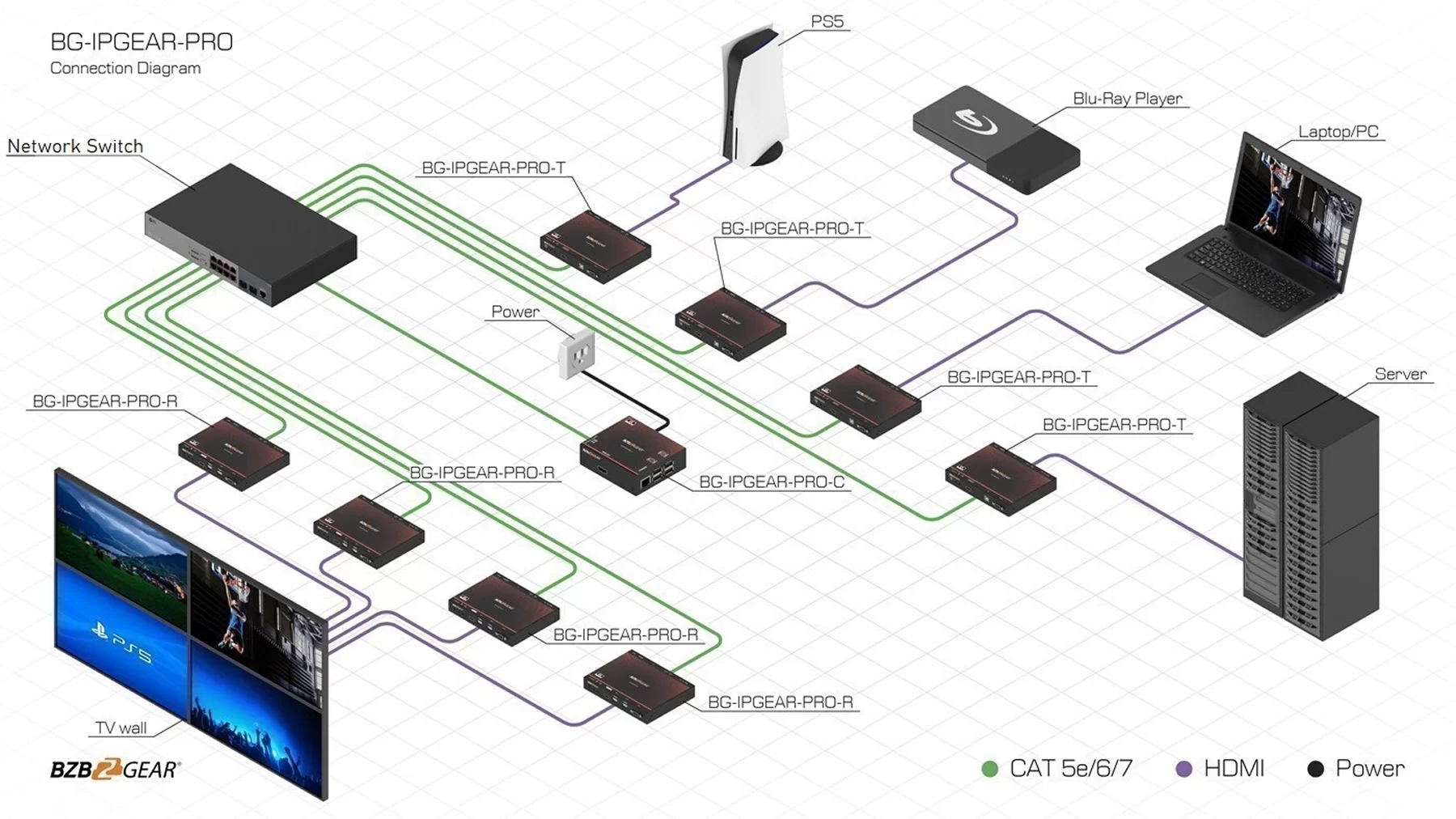
Here's the trap that catches more projects than any other: the fixed box. You spec a traditional matrix switcher — say an 8x8 — and it's perfect for the room you were handed. Then the scope grows. The client adds a breakout space, a second lobby screen, another source. Now you're staring at a switcher with no ports left, and the only fix is swapping the whole thing. That's an expensive, awkward conversation to have.
The way out is to stop thinking in fixed input and output counts. AV over IP (AVoIP) puts your video on a standard network instead of a dedicated switcher. Each source connects to an encoder, each display to a decoder, and a network switch does the routing. Think of it like the difference between a building wired with a fixed number of phone lines versus one running on the office network — adding an endpoint is just plugging in another device, not re-running cable to a central box.
That single shift changes the math. Need another source? Add an encoder. Another screen? Add a decoder. The system grows one device at a time instead of hitting a wall. BZBGEAR's AV over IP lineup is built exactly for this — standardized transmitter and receiver units, PoE to simplify cabling, and controllers that manage large device counts on one network. You design for today's room and let the network carry tomorrow's.
Distance That Breaks the Signal
The second challenge is physical. HDMI is a wonderful standard until you need to run it much past 15 to 25 feet at 4K, at which point a plain passive cable starts to get unreliable fast. Stretch a signal across a large venue, between floors, or building to building, and it simply won't make it.
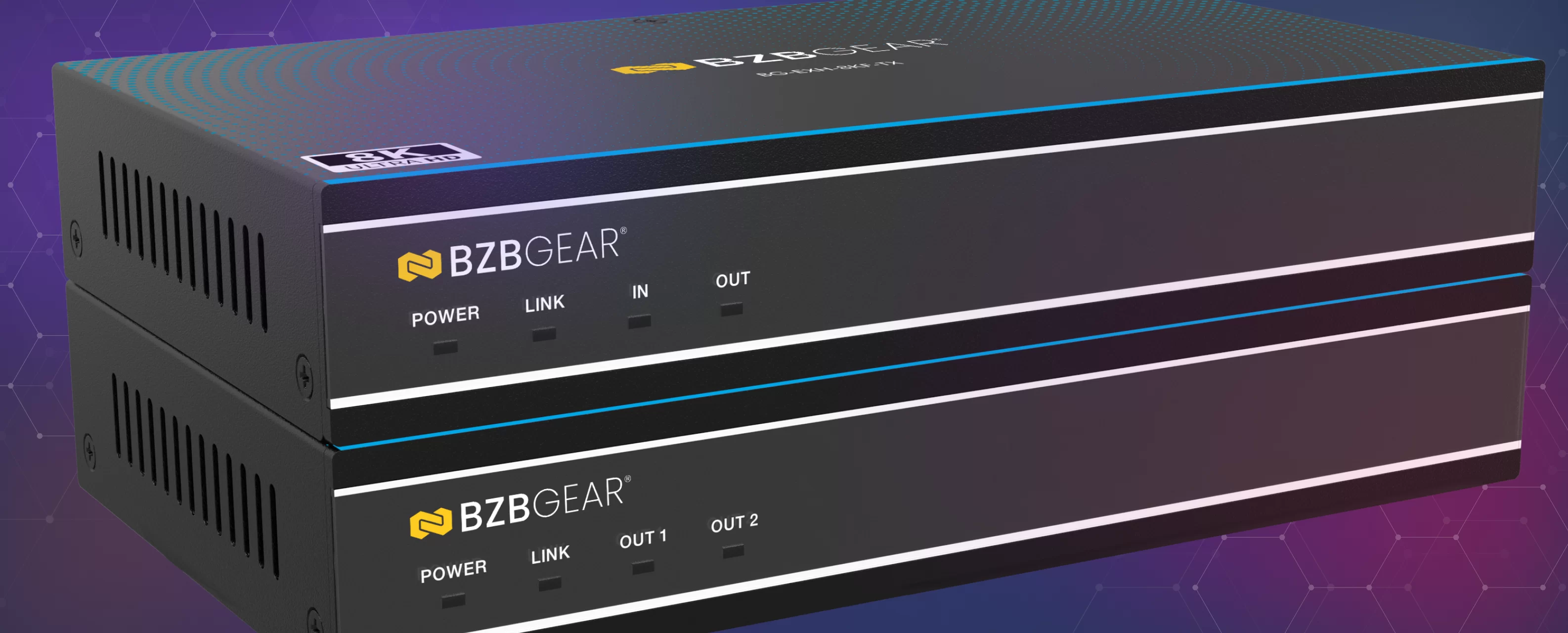
This is a solved problem, and the solution is matching the transport to the distance. For runs within a facility, an HDBaseT extender like the BG-EXH-150C carries 4K over a single Cat5e/6 cable up to 490 feet — well past HDMI's native limit. For the long backbone — a run between floors or across a campus — fiber is the safe bet, because it carries enormous bandwidth over enormous distances without becoming the bottleneck; an 8K HDMI 2.1 over fiber extender (BG-EXH-8KF) handles 8K60 and 4K120 across a multimode run. The design principle is simple: figure out the longest run first, then pick the transport that clears it with margin to spare rather than designing right up to the edge of what a cable can do.
Too Many Formats in One Room
Walk into almost any real installation and you'll find a format zoo. There's an HDMI source over here, an SDI camera feed over there, a presenter's USB-C laptop, maybe a legacy input nobody wants to retire. The complexity isn't any one signal — it's getting them all to coexist and land cleanly on whatever displays the room uses.
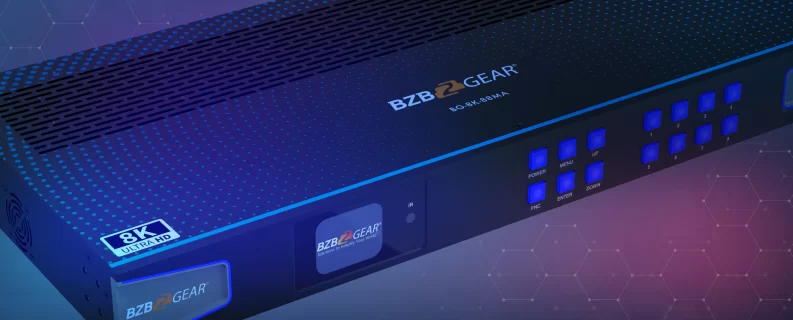
The answer is treating conversion and scaling as part of the design, not an afterthought. A matrix switcher with built-in scaling — such as the BG-8K-88MA, an 8x8 8K HDMI 2.1 matrix with auto-downscaling — can take mismatched resolutions and normalize them so every display gets a signal it can actually show. A cross converter like the BG-4KBHS-PRO bridges the gap between HDMI and SDI in both directions, so a camera in one language reaches a display in another. And planning around EDID — the handshake where a source learns what a display can handle — heads off the "black screen for no reason" problems before they start. Handle the format layer deliberately and the room just works, no matter what someone plugs in.
Getting Content Beyond the Four Walls
More and more, the room isn't the whole audience. A house of worship wants its service online. A boardroom presentation needs to reach remote staff. A lecture has to be recorded for students who couldn't attend. What used to be a distribution job is now a distribution-plus-streaming job, and bolting on a separate streaming system after the fact is where projects get messy.
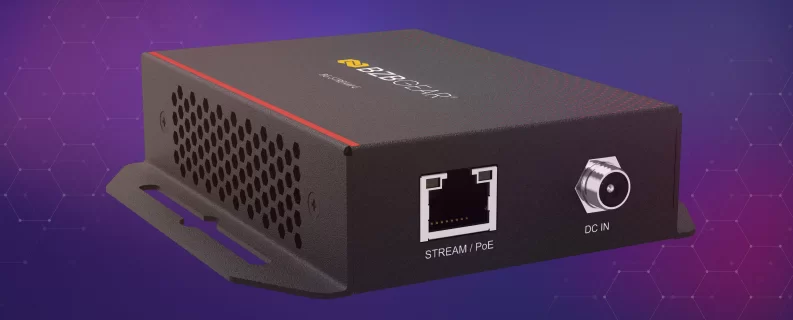
The cleaner approach is to build streaming into the signal path from the start. A streaming encoder like the BG-STREAM-E takes the same content you're routing on-premises and pushes it out over the common protocols — H.264/H.265, RTSP, RTMP, SRT, NDI HX — so the feed can be streamed or recorded without a parallel rig. BZBGEAR's full line of streaming encoders and decoders speaks those standards, which means the on-site system and the online audience run off one workflow instead of two. When streaming is designed in rather than added on, it stops being the fragile part of the install.
Reliability the Client Never Thinks About
The last challenge is the one that doesn't show up on install day at all. Commercial AV lives a hard life — a PTZ camera in a worship space runs every weekend for years; an AVoIP encoder in a conference room powers on every single morning. The gear that fails in year three was often the cheapest line item in year one. For an integrator, that failure is a callback, a truck roll, and a dent in the relationship.
This is why longevity belongs in the spec right next to resolution and price. A long warranty is really a manufacturer telling you, in writing, how long they expect their gear to keep working — they set those terms from real field data. BZBGEAR backs its Pro Line with a five-year warranty — plus a lifetime warranty on cables — and pairs it with US-based technical support, so the person answering the phone actually knows the product. A system that's still supported in year four is a system you're not rebuilding in year four.
The Bottom Line
Complex AV challenges tend to come from the same short list: systems that can't grow, distances that break the signal, formats that won't cooperate, content stuck inside four walls, and gear that doesn't go the distance. None of them are unsolvable — they're just decisions best made at the design stage rather than discovered on site. Build on a network so the system is never full, match your transport to your distances, handle formats deliberately, design streaming in from the start, and spec gear that's built and backed to last. Do that, and the "complex" projects start looking a lot more routine.
If you're scoping a project and want a second set of eyes on the tricky parts, reach out — we're happy to help you spec it out. Explore the full lineup at BZBGEAR.com.


8.00 a.m. - 5.00 p.m. (PST)
10.00 a.m. - 3.00 p.m. (PST)
(by appointment only)