







HDMI 2.1: What Integrators Need to Know in 2026
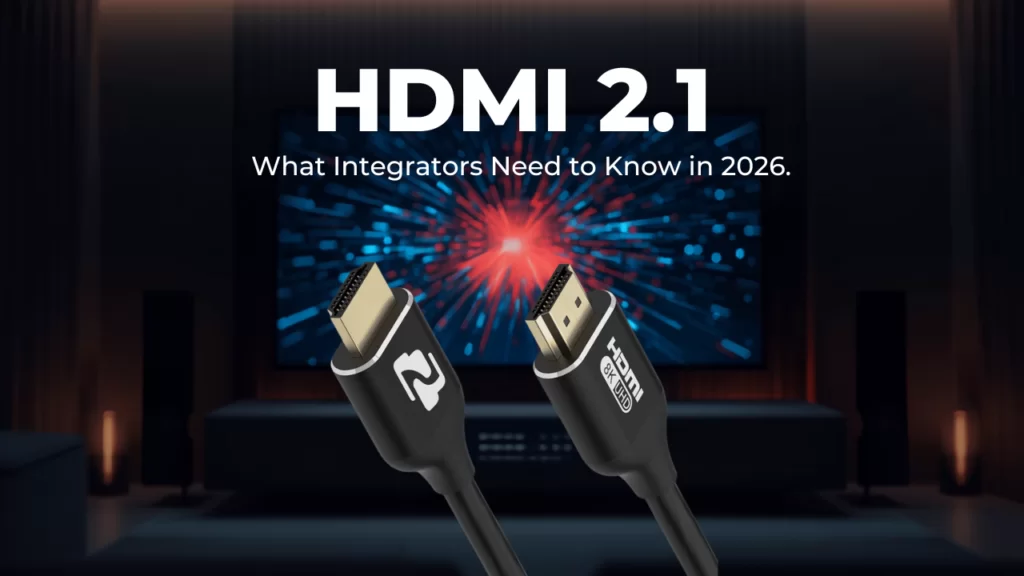
Open any product spec sheet in 2026 and you'll see "HDMI 2.1" printed on just about everything — displays, matrix switchers, extenders, source devices, even the cables. It's become the default badge for "modern AV." But here's the thing every integrator learns eventually: that label tells you far less than you'd expect. Two devices can both claim HDMI 2.1 and deliver wildly different performance.
So before you spec your next high-bandwidth system, let's break down what HDMI 2.1 actually means, where the spec sheets get slippery, and what to verify so the finished install performs the way the paperwork promised.
What HDMI 2.1 Actually Delivers
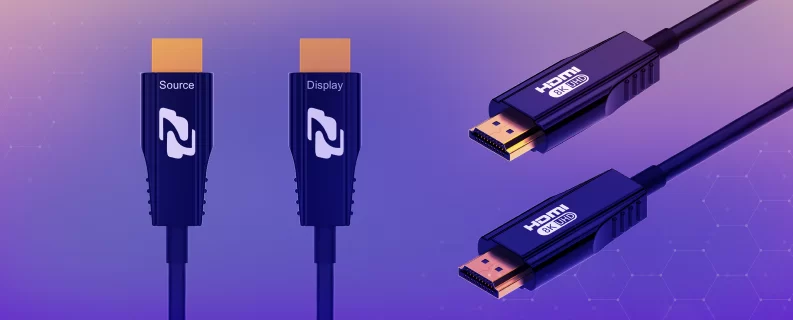
At its core, HDMI 2.1 is a big jump in bandwidth. The previous generation, HDMI 2.0, topped out at 18Gbps. HDMI 2.1 pushes that ceiling all the way to 48Gbps — enough headroom to carry uncompressed 4K at 120Hz or 8K at 60Hz, with full chroma and higher color depth.
It gets there using a new signaling method called Fixed Rate Link (FRL). Older HDMI versions used a scheme called TMDS; FRL is a more efficient approach that moves data in defined tiers — 9, 18, 24, 32, 40, and 48Gbps. That tiered structure matters, because a device only has to support the tiers its designer chose to include. More on that in a moment.
HDMI 2.1 also introduced a bundle of features that go beyond raw resolution:
- Variable Refresh Rate (VRR) and Auto Low Latency Mode (ALLM) — originally aimed at gaming, but increasingly relevant for interactive displays and simulation.
- Enhanced Audio Return Channel (eARC) — carries lossless, high-bitrate audio like Dolby Atmos back from a display to an AVR or soundbar.
- Quick Media Switching (QMS) and Quick Frame Transport (QFT) — cut the black-screen delay when content changes resolution or frame rate.
- Display Stream Compression (DSC) — a visually lossless compression standard that squeezes even higher resolutions through the pipe.
Together, that's the "gold standard" reputation HDMI 2.1 has earned. The catch is that almost none of it is guaranteed by the label alone.
The Label Problem: Why "HDMI 2.1" Isn't a Guarantee
Here's the part that trips up even seasoned installers. When the HDMI Forum rolled out 2.1, it made nearly all of those headline features — the full 48Gbps bandwidth, VRR, ALLM, DSC — optional. A device can legally wear an "HDMI 2.1" badge while supporting just one 2.1 feature and only 18Gbps of bandwidth. In other words, the same throughput as HDMI 2.0, with a shinier sticker.
For a home theater, that's an annoyance. For a commercial install where you're counting on full bandwidth to push 8K60 or 4K120 down the chain, it's a real problem. You can wire everything up perfectly, verify every connection, and still end up with a downscaled image because one device only supports a fraction of the spec.
The fix is simple discipline: read the spec, not the label. Before you buy anything for a high-bandwidth job, confirm it explicitly states 48Gbps FRL support — not just "HDMI 2.1." On displays with multiple inputs, check the specs port by port, since manufacturers often label every port 2.1 when only one or two actually run at full bandwidth. If a data sheet won't give you a straight bandwidth number, treat that as your answer.
Cables Are Half the Battle
You can spec every component correctly and still get a black screen if the cable can't keep up. HDMI 2.1's higher frequencies are far less forgiving than previous generations, and a cable that looks identical to the last one can quietly cap your signal.
This is where certification earns its keep. The Ultra High Speed HDMI Cable is the only cable category tested and certified to carry the full 48Gbps, with every certified cable required to pass mandatory testing at an authorized HDMI test center. Look for the certification label with green text and a QR code you can scan with the HDMI verification app to confirm it's genuine — counterfeit labels are common enough that scanning is worth the ten seconds. Generic "Premium High Speed" cables, by contrast, are only rated to HDMI 2.0 speeds no matter what the marketing says.
One more physics reality to plan around: passive copper HDMI 2.1 cable is only reliable to about 3 meters (roughly 10 feet). Beyond that, signal integrity falls off fast, and you'll start chasing intermittent dropouts and failed HDCP handshakes. For any real distance, you'll want active optical cable or a dedicated extender.
Distance and Routing in the Real World
Most commercial installs aren't a source sitting three feet from a display. You've got long runs, multiple sources, and several destinations — exactly the conditions where full-bandwidth HDMI 2.1 gets hard to hold onto.
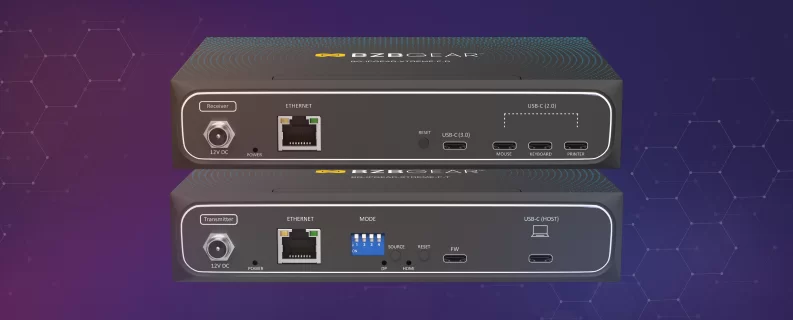
For long runs, fiber solves the distance problem cleanly. A dedicated HDMI 2.1 fiber extender like the BG-IPGEAR-XTREME-F carries uncompressed 4K60 4:4:4 — and visually lossless DSC-compressed 4K144 — over single-mode fiber for up to 10km, so the length of the run stops being a design constraint.
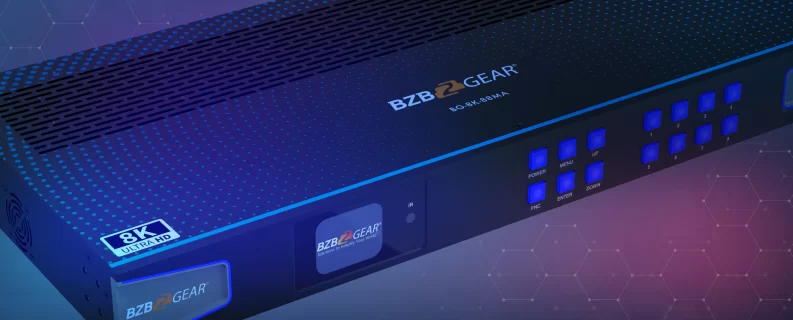
For routing multiple high-bandwidth signals, a purpose-built matrix switcher beats chaining single-purpose devices, which only adds failure points. The BG-8K-88MA routes eight true HDMI 2.1 sources to eight displays with full 48Gbps support, plus built-in auto-downscaling, audio de-embedding, and EDID management. That last point is underrated: in a multi-display system, solid EDID handling is what keeps sources and displays negotiating the right format instead of falling back to a black screen.
What About HDMI 2.2?
If you're speccing for 2026, you've probably heard the drumbeat about HDMI 2.2. It's real — officially revealed at CES 2025 — and it roughly doubles the ceiling to 96Gbps over a new "Ultra96" cable, enabling formats like 4K240 and uncompressed 8K60, with theoretical support reaching 10K, 12K, and even 16K. It also adds a Latency Indication Protocol (LIP) to improve audio-video sync across multi-hop chains like an AVR-and-soundbar setup.
Here's the practical read for integrators: HDMI 2.2 is on the horizon, not on your job site. Real 2.2 source and display hardware isn't expected to arrive in meaningful volume until 2027, and it will require those new Ultra96 cables to hit full speed. The good news is that HDMI 2.2 is backward compatible, so 2.1 gear won't be stranded. For today's installs, HDMI 2.1 remains the right target — just spec it honestly, and run quality infrastructure so you're ready when 2.2 devices actually land.
The Bottom Line
HDMI 2.1 is genuinely powerful, but in 2026 the badge is the beginning of the conversation, not the end of it. Verify full 48Gbps FRL support instead of trusting the label, insist on certified Ultra High Speed cables, plan for distance with fiber or extenders, and simplify multi-source routing with a matrix switcher that manages EDID for you.
Speccing a high-bandwidth HDMI 2.1 system and want a second set of eyes on the design? Reach out to the BZBGEAR team, or explore the full lineup of 8K-ready switchers, extenders, and distribution gear at BZBGEAR.com — we'd love to help make sure your system performs exactly the way the spec sheet promised.


8.00 a.m. - 5.00 p.m. (PST)
10.00 a.m. - 3.00 p.m. (PST)
(by appointment only)