







Can I Mix Different Speaker Types on One Amplifier?
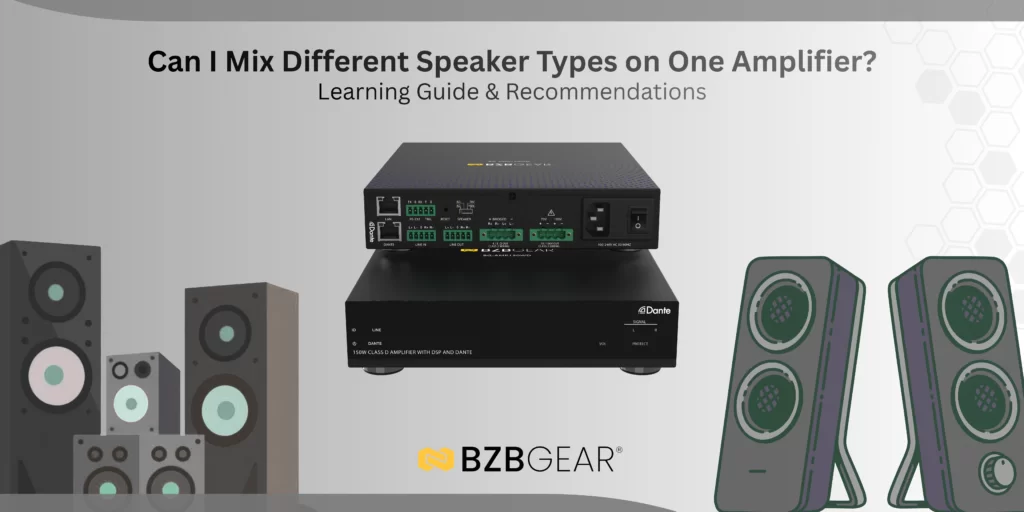
Yes, but only when the system is designed and wired correctly. The real limitation isn’t the speakers themselves; it’s how the amplifier handles electrical load, impedance, and system mode.
Most audio issues in mixed-speaker setups come from incorrect wiring or impedance mismatches, not from the speaker brands or types.
What “Mixing Speakers” Actually Means
When users ask this question, they’re usually referring to one of the following:
- Mixing different speaker brands (ceiling, wall, pendant, etc.)
- Combining different speaker sizes or wattage ratings
- Running multiple speakers on a single amplifier channel
- Mixing commercial 70V speakers with low-impedance speakers
The important concept is this:
- You are not just mixing speakers, you are combining electrical loads on an amplifier output. And even if the speakers all look small, it’s the type that matters.
Step 1: Know Your Amplifier Type
Before connecting anything, identify which system you are working with:
Low-Impedance (Lo-Z) Systems
- Typical speaker ratings: 4Ω, 6Ω, 8Ω
- Common in: homes, studios, small AV installs
- Wiring sensitivity: high
Key behavior:
- Each added speaker changes total load
- Impedance drops when speakers are wired in parallel
- Incorrect wiring can quickly overload the amplifier
........................................................................................................................................
High-Impedance (Hi-Z / 70V / 100V) Systems
- Uses transformer-based 70V or 100V speakers
- Common in: commercial installations (offices, schools, retail)
- Wiring sensitivity: low
Key behavior:
- Speakers connect in parallel along a voltage line
- Each speaker draws only the power it needs
- System is designed for scalable speaker expansion
Step 2: Can You Mix Different Speaker Types?
Yes, but only within the same system type.
Allowed
- Different speaker brands in a Lo-Z system (as long as impedance matches)
- Multiple 70V speakers in a Hi-Z system
- Mixing speaker sizes when power ratings are properly matched
Not Allowed
- Mixing Lo-Z and Hi-Z speakers on the same amplifier output
- Ignoring impedance and wiring requirements
- Combining speakers without calculating total load
Step 3: The Key Factor - Impedance
The amplifier doesn’t “see” speaker brand or size. It only sees the total impedance load (Ω). This is where most system failures occur.
In Low-Impedance Systems
When speakers are added in parallel:
- Total impedance decreases
- Lower impedance = higher current draw
- Too low = amplifier overheating, distortion, or shutdown
Example:
- Two 8Ω speakers in parallel > 4Ω total - (safe for most amps)
- Two 4Ω speakers in parallel > 2Ω total - (too low for most amplifiers)
...........................................................................................................................................
In High-Impedance Systems
In 70V/100V systems:
- Each speaker uses a transformer tap
- Load is distributed across the system
- Adding speakers has minimal impact on total impedance
This is why large installations can scale easily without complex calculations.
Step 4: Why Amplifier Mode Matters
Many modern amplifiers (including DSP enabled models like the BG-AMP150WD) can operate in:
- Low-Impedance mode (4–8Ω)
- High-Impedance mode (70V/100V)
This flexibility is powerful, but it introduces one critical rule:
You must select ONE operating mode before connecting speakers.
Mixing system types within the same amplifier output is not supported, even if the hardware allows both modes.
Step 5: Best Practices for Safe Speaker Mixing
1. Assign one channel per zone
Keep each amplifier channel dedicated to a specific room or area.
2. Maintain impedance limits
For most low-impedance systems, stay at or above 4Ω per channel.
3. Use 70V systems for larger speaker counts
When scaling multiple speakers across a building, Hi-Z systems simplify design and eliminate most impedance concerns.
4. Group speakers by function
Instead of random mixing, organize by purpose:
- Ceiling speakers > ambient/background audio
- Wall speakers > directional or foreground audio
stable, scalable, and efficient, regardless of speaker brand or form factor.


8.00 a.m. - 5.00 p.m. (PST)
10.00 a.m. - 3.00 p.m. (PST)
(by appointment only)