







Behind the Design: How BZBGEAR Develops New AV Products
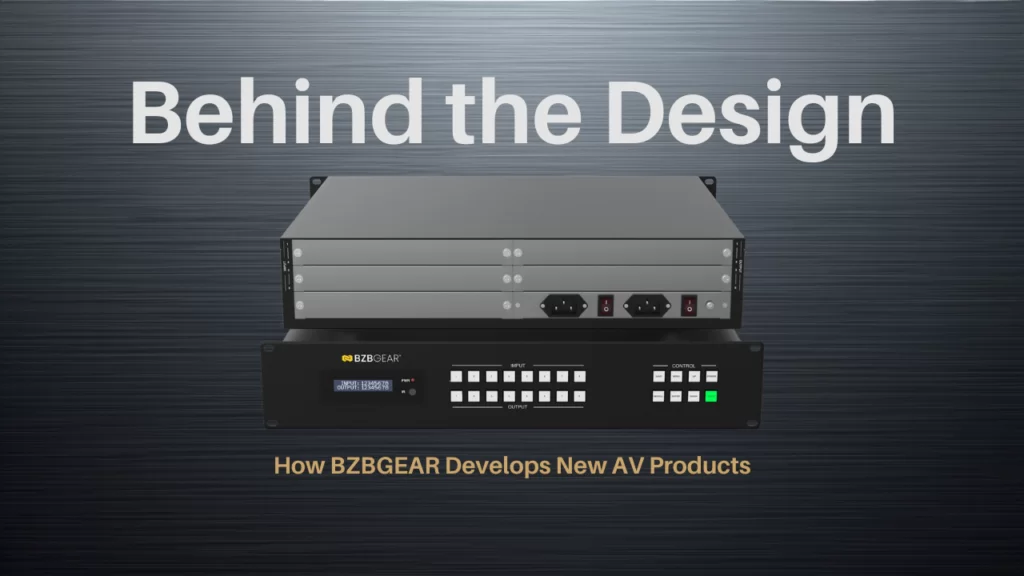
Ever look at a piece of AV gear and wonder how it ended up on the shelf? A question we get a lot is some version of, "How do you decide what to build next?" And it's a fair one. In a world flooded with cameras, encoders, switchers, and extenders, it's easy to assume new products just appear because a spec sheet said they should.
The truth is a little more human than that. At BZBGEAR, the best ideas don't start in a lab. They start with you — the integrators, technicians, and end users out in the field, wrestling with a real problem on a real install. Here's how a conversation on a job site turns into a product you can actually deploy.
It Starts With a Problem, Not a Product

Most of our best products began as a complaint. Someone couldn't get a clean signal to run far enough. A house of worship needed a camera operator who didn't exist in the budget. A classroom setup had one too many boxes and one too few outputs.
We hear these stories constantly — from support calls, trade show conversations, and the integrators we work with every day. When the same frustration keeps surfacing from different corners of the industry, that's the signal. It tells us there's a gap between what the market offers and what people out there actually need.
So before anyone sketches a design, we're mostly just listening.
Turning Field Feedback Into a Spec

Once a pattern is clear, the real work begins: translating a messy, real-world headache into a concrete set of requirements. This is where customer feedback stops being anecdotes and starts becoming engineering targets.
Think of it like a translator sitting between two rooms. In one room, an installer is saying, "I just need this to work when I plug it in, and I don't want to babysit it." In the other room, engineers need numbers — resolutions, latency budgets, port counts, power draw, operating temperatures. Our job in product development is to carry the intent from the first room into the second without losing what actually mattered to the user.
That's why our feature lists tend to be practical rather than flashy. We ask questions like: Will this survive a long day in a hot equipment rack? Can a solo operator run it without a manual open on their lap? Does it play nicely with the gear people already own? If a feature doesn't earn its place by solving a genuine problem, it usually doesn't make the cut.
Prototype, Test, Break, Repeat
Here's the part that isn't glamorous but matters the most. A working idea and a working product are two very different things.
Every design goes through rounds of prototyping and hands-on testing long before it's offered for sale. We push products in the conditions they'll actually face — extended run times, mixed-brand signal chains, less-than-ideal cabling, the kind of real-world messiness that a pristine test bench never replicates. If something is going to fail, we'd much rather it fail on our bench than during your live event.
And when a prototype does fall short? Good. That's the point. Every failure is feedback, and every round of feedback makes the final product more reliable. It's a lot like a rehearsal — you run it, you find the rough spots, you fix them, and you run it again until it's smooth.
Designed to Be Easy on Purpose

There's one principle that runs through everything we build: it should be easy to use. Not "easy once you read the 40-page guide" — easy right out of the box.
That focus on simplicity isn't an accident, and it isn't a marketing line. It's a direct response to what customers tell us they want. AV professionals are busy, budgets are tight, and nobody has time to fight with their equipment. So we sweat the small details — clear labeling, sensible defaults, interoperability, straightforward controls — because those are the things that turn a stressful install into a smooth one.
Built With You, For You

At the end of the day, developing a new AV product isn't really about chasing the newest chip or the biggest spec. It's about paying attention. The gear that ends up carrying the BZBGEAR name is shaped, tested, and refined around the people who use it, whether you're running a broadcast, a classroom, a sanctuary, or a stadium.
So the next time you're planning your next installation and something in our lineup fits your project perfectly, it's probably not a coincidence. There's a good chance it was built to solve exactly the kind of problem you're facing — because someone like you told us about it first.
Have an idea for something we should build, or a challenge you're trying to solve? We'd love to hear it. Reach out to the BZBGEAR team anytime, and explore the full lineup at BZBGEAR.com.


8.00 a.m. - 5.00 p.m. (PST)
10.00 a.m. - 3.00 p.m. (PST)
(by appointment only)