



Avoiding Network Conflicts in Multi-Camera Setups
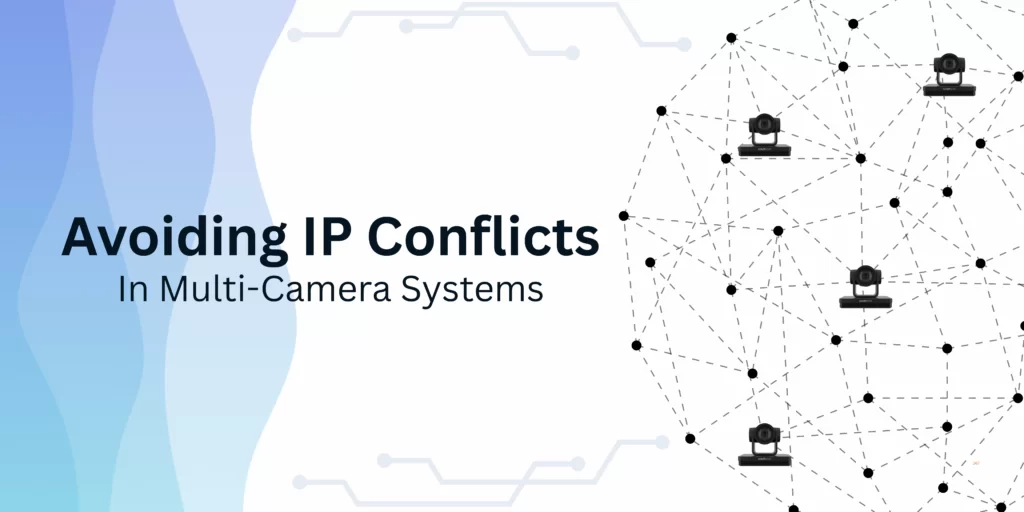
In multi-camera systems, IP address conflicts can cause a wide range of issues, including loss of camera control, network dropouts during streaming, cameras behaving unpredictably, or multiple cameras responding simultaneously as if they were a single device. These problems are often difficult to diagnose because they can appear random or seem related to unrelated factors.
IP conflicts are especially common in multi-camera environments because many systems use cameras from the same manufacturer or model line, which often share the same default IP address. Below are best practices for preventing IP conflicts, as well as steps to take if you believe one has already occurred.
Preventing IP Conflicts During Setup
When setting up multiple cameras, it is best practice to power on and connect only one camera to the network at a time. A common mistake is fully installing and powering all cameras before configuring network settings. While this approach may seem faster, it can lead to conflicts if multiple cameras are using the same default IP address. And in most cases, it is difficult for users to troubleshoot at this point, as they have mounted their cameras and cleaned up the cable runs.
When multiple devices share an IP address, any network or firmware changes applied to one camera may unintentionally affect another, since the network cannot distinguish between devices assigned to the same address sometimes.
If needed, review the camera manuals to confirm default IP addresses. In some cases, manufacturers assign sequential or unique defaults for different model lines.
As you configure each camera:
- Assign a unique IP address
- Verify that all network settings are fully saved and applied
- Confirm proper communication before moving on to the next camera
Troubleshooting IP Conflicts
If your system is already set up and you suspect an IP conflict, the most reliable troubleshooting method is to check each camera individually. When possible, power on and test one camera at a time to confirm its IP address and behavior.
If isolating cameras is not feasible, identify the camera experiencing issues and temporarily power it off. Then, attempt to ping its IP address. If the address still responds, another device is using that same IP. This device may not be another camera—it could be a PC, other production equipment, or even a security camera outside the building if it happens to be on the same network.
Once an IP conflict is identified:
- Use an IP scanning tool or log into your router or network switch
- Determine which IP addresses are already in use
- Assign an available IP address to the affected camera
Note: If the conflicting device prevents you from accessing the camera’s settings, disconnect the camera from the main network and connect it directly to your PC, or move it to an isolated network switch or hub. This allows you to reconfigure the camera without interference.
Best Practices to Avoid IP Conflicts During Operation
- Avoid leaving DHCP enabled on cameras. While DHCP simplifies initial setup by assigning available IP addresses automatically, DHCP lease renewals can cause IP addresses to change after reboots or network disruptions, such as power outages.
Use a dedicated network for cameras and production equipment whenever possible. Keeping these devices on a separate network—or at least a dedicated network switch—makes device management easier and significantly simplifies troubleshooting.


8.00 a.m. - 5.00 p.m. (PST)
10.00 a.m. - 3.00 p.m. (PST)
(by appointment only)
